
Hampton Roads Crawl Space Journal
Expert field notes on crawl space moisture, structure, and building performance from 25 years beneath coastal Virginia homes
Watch The Full Video
Why Hampton Roads Crawl Spaces Are Different From the Rest of Virginia
By Robbie McCarty | Patriot Crawl Space Repairs | Structural Repairs
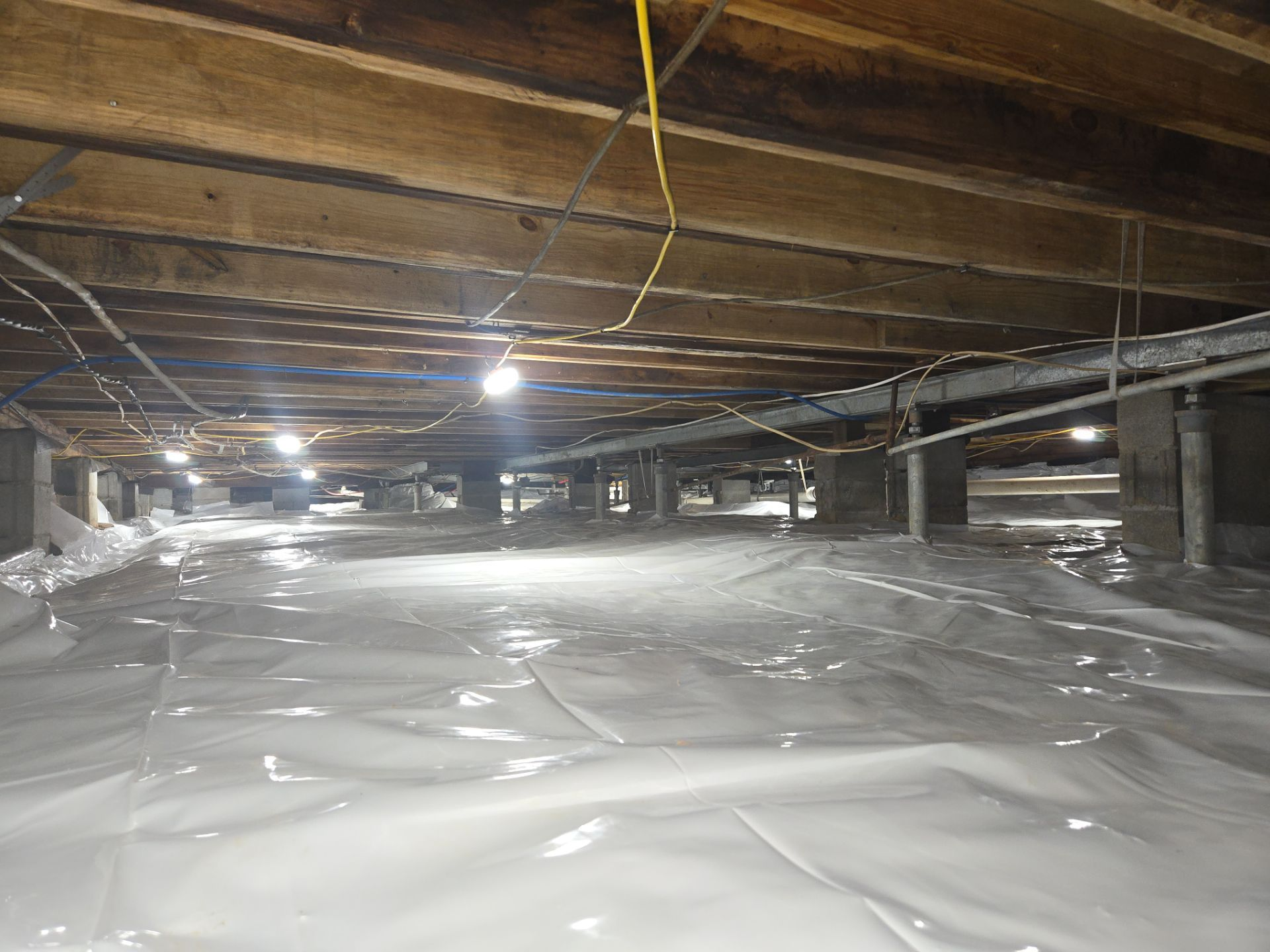
Most of the crawl space methods being sold in Hampton Roads were developed for hill and mountain regions — and a significant number of the failures we correct were caused by applying those methods to a coastal environment they weren't designed for. Understanding why Hampton Roads crawl spaces behave differently is the starting point for understanding why the repair approach has to be different too.
What Makes a Coastal Crawl Space Different
Hampton Roads sits in what the crawl space industry calls a coastal region. Along the eastern seaboard from Delaware down through Virginia, North Carolina, South Carolina, Georgia, and Florida, the terrain is flat, the land is low, and water tables fluctuate significantly throughout the year. That combination creates crawl space conditions that simply don't exist in higher elevation regions of Virginia.
In the hills around Richmond or in the mountains of western Virginia, crawl spaces behave predictably. The terrain has pitch to it. If water enters a crawl space it flows to the lowest point — usually one identifiable corner or section — and a single sump pump at that low point handles it. The water table isn't rising around the entire foundation because the foundation is elevated well above it. Encapsulation in those environments is straightforward: identify where water collects, manage it with drainage, seal the liner to the walls, and the system performs reliably.
Hampton Roads is the opposite of that environment in almost every relevant way.
The Water Table Problem
In coastal Virginia the water table doesn't behave like it does in elevated regions. It rises around the entire foundation simultaneously. There's no predictable low point where water will collect because the ground is essentially flat — water doesn't flow toward a corner, it rises from below across the entire footprint of the home.
This creates a specific risk for fully sealed encapsulation systems. When a liner is bonded wall-to-wall and sealed to the foundation piers without a full perimeter drain and sump pump installed, the system has no mechanism to handle water table rise. If groundwater rises beneath that liner — which in Hampton Roads can happen during a wet season even in a crawl space that looked completely dry at inspection — the entire underside of the liner becomes a dark wet surface. Mold establishes across that surface. Within a year or two the smell works its way into the living space and the entire liner system has to be ripped out and replaced.
This isn't a hypothetical. We see the aftermath of this failure regularly in Hampton Roads — expensive encapsulations installed by companies that brought coastal encapsulation methods from inland regions and applied them without accounting for how coastal water tables actually behave.
The Clearance Problem
Beyond the water table, Hampton Roads crawl spaces present a physical challenge that inland crawl spaces typically don't: they're extremely low.
In the mountains or around Richmond, crawl spaces often have enough clearance to stand or at least crawl on hands and knees. Some of them are used for storage — kayaks, seasonal items, equipment. The practical reality of working in them is manageable.
In Hampton Roads most crawl spaces require military crawling or rolling to navigate. You cannot get to your hands and knees in a significant portion of them. That physical reality has several important implications for how encapsulation systems should be designed:
A fully sealed liner bonded to walls and piers in a low clearance Hampton Roads crawl space cannot be cleaned or properly serviced. Inspectors cannot realistically pull it back to examine the foundation wall perimeter. When trades need to perform HVAC, plumbing, or electrical work in that space they charge more because they have to work around and rehabilitate the liner. The system that was installed to protect the home becomes a maintenance obstacle.
A pin liner in that same space — good thick plastic, solid ground coverage, not bonded to the walls — stays manageable. It can be pulled back for inspection. Trades can work without destroying it. If conditions change it can be adapted without a full removal.
The Termite Problem
Hampton Roads has significant termite and wood destroying insect activity. That's a function of the warm coastal climate and the moisture conditions that support wood destroying insect populations throughout the region.
Effective termite management requires visual inspection of the foundation wall and the wall-to-ground connection — the areas where termite activity most commonly originates and where early detection is possible before significant structural damage occurs.
A fully sealed liner bonded to the foundation walls covers exactly those surfaces. The most important inspection points for termite monitoring become inaccessible behind an expensive liner that nobody is going to cut open for a routine termite inspection. The encapsulation that was supposed to protect the home is actively interfering with the monitoring that protects its structural framing from one of the most serious threats in this region.
What the Research Actually Says About Coastal Crawl Spaces
This isn't just field observation — it's consistent with what crawl space building science research has concluded about coastal environments. Major research institutions studying crawl space performance in coastal regions have consistently found that maintaining inspectability and durability is more important in flat coastal environments than achieving a perfect liner seal.
The reason is straightforward: in a coastal environment with fluctuating water tables and unpredictable groundwater behavior, a system that can be inspected and adapted over time outperforms a system optimized for appearance on installation day. The perfect sealed white liner that photographs beautifully is not the right system for a Hampton Roads crawl space unless a full perimeter drain and sump pump are installed with it to handle whatever the water table does over the next 20 years.
Where Moisture Actually Comes From in Hampton Roads
Understanding the right encapsulation approach requires understanding where the moisture actually originates — because the liner's job is often misunderstood in the way it gets marketed.
In Hampton Roads the primary moisture source is humid outdoor air entering through foundation vents and crawl space openings. That air contacts cool surfaces beneath the home and condensates — depositing moisture on framing, insulation, pipes, and ductwork. This happens above the liner. The liner has no effect on it whatsoever.
The secondary moisture source is groundwater rising into the space from the soil. This needs drainage — not plastic laid over the top of it.
What actually controls the primary moisture source is sealing the foundation vents and installing a dehumidifier to manage the air in the space mechanically. The liner covers the ground, provides a clean surface, and adds a modest layer of ground moisture separation. That's its actual role — and in coastal Virginia a pin liner does that job just as effectively as a fully sealed system while preserving the inspectability and adaptability the space needs.
Sealing the liner to the walls in Hampton Roads primarily makes sense in one specific situation: where the yard grade is significantly higher than the foundation wall on one or more sides, creating a lateral moisture pathway through the wall itself. In flat coastal Virginia that condition is uncommon. In mountain or piedmont regions where yards may be four feet above the foundation wall on the uphill side, sealing the liner to that wall makes real sense. The application has to match the actual conditions.
What This Means When You're Evaluating Crawl Space Proposals
If a crawl space company is proposing a fully sealed liner system for your Hampton Roads home without discussing drainage, sump pump installation, and long-term groundwater risk — ask them directly how they're accounting for water table fluctuation beneath the liner.
If they're proposing a sealed liner in a low clearance Hampton Roads crawl space — ask them how future trades access will be managed and how they plan to maintain inspection access to the foundation wall perimeter for termite monitoring.
A company that has actually worked in Hampton Roads crawl spaces over time has answers to both questions. A company that has imported inland encapsulation methods into a coastal market doesn't.
The Bottom Line
Hampton Roads crawl spaces are low, flat, coastal, and subject to water table behavior that doesn't exist in elevated regions of Virginia. The encapsulation methods that work in the mountains and hills of Virginia were not designed for these conditions — and applying them without accounting for coastal groundwater behavior, low clearance realities, and termite monitoring requirements produces failures that are expensive to correct.
We design crawl space systems around how these spaces actually behave over time — not around what looks best on installation day.
If you want an assessment from someone who has spent 25 years learning what actually works beneath Hampton Roads homes, I'll come out and take a look personally.
Proudly serving homeowners throughout Hampton Roads including Newport News, Yorktown, Poquoson, Hampton, Norfolk, Virginia Beach, Chesapeake, Suffolk, Williamsburg, Gloucester, and surrounding areas.
About The Author
Robbie McCarty is the owner of Patriot Crawl Space Repairs and a Virginia Class A Residential Building Contractor (DPOR #2705176108) and MICRO Certified Mold Remediation contractor with over 25 years of crawl space repair experience throughout Hampton Roads and coastal Virginia. He has personally evaluated and repaired thousands of crawl spaces beneath homes in Suffolk, Chesapeake, Virginia Beach, Norfolk, Newport News, Williamsburg, and surrounding communities.
