
Hampton Roads Crawl Space Journal
Expert field notes on crawl space moisture, structure, and building performance from 25 years beneath coastal Virginia homes
Watch The Full Video
25 Years Under Hampton Roads Homes: What We've Learned That Most Companies Get Wrong
By Robbie McCarty | Patriot Crawl Space Repairs | Structural Repairs
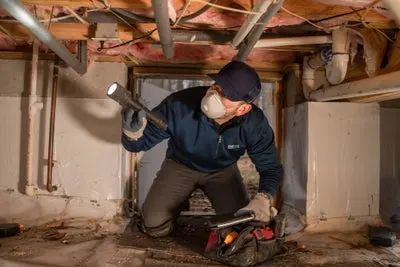
After more than 25 years of inspecting and repairing crawl spaces throughout Hampton Roads I can say with near certainty that there are three things consistently misunderstood about coastal Virginia crawl spaces — and all three go against what most crawl space companies in this market are selling. These aren't theories. They're observations from thousands of inspections beneath real homes in this specific region.
First: Hampton Roads Crawl Spaces Are Unlike Most of Virginia
Before getting into what we've learned it's worth establishing why Hampton Roads is different in the first place.
If you've been in crawl spaces in Richmond or the mountains of Virginia you know what a normal crawl space feels like — enough clearance to move around, sometimes enough to stand. Hampton Roads crawl spaces are a different environment entirely. Most of them you can barely roll over in. You're not crawling upright. You're working in extremely confined spaces with low clearance, high humidity, and soil conditions that behave nothing like inland Virginia.
The combination of low elevation, coastal humidity, fluctuating water tables, clay soils, and the unusually low clearance common in this region creates conditions that require a fundamentally different approach than what works everywhere else. What we've learned over 25 years is specific to this environment — and that specificity is what most companies operating here are missing.
Lesson One: Full Encapsulation Causes More Problems Than It Solves in Many Hampton Roads Crawl Spaces
This is the observation that most directly contradicts what the large crawl space companies are selling in this market — and it's the one we're most confident about after 25 years of watching what happens to these systems over time.
A fully sealed encapsulation system — liner bonded to walls and piers, taped seams, dehumidifier — assumes a predictable moisture environment beneath the home. In Hampton Roads that assumption regularly fails.
Water tables in this region fluctuate dramatically throughout the year. A crawl space that's dry during an inspection in late summer can have active groundwater intrusion during a wet spring. When a fully sealed liner is in place and that groundwater appears, it has nowhere to go. It pools beneath the liner. Mold establishes on the underside of that liner in a dark wet environment where nobody can see it. Within a few years the smell works its way into the living space and the entire liner system has to come out.
There's a secondary problem that rarely gets discussed: trades accessibility. Hampton Roads homes need regular HVAC, electrical, and plumbing work in the crawl space throughout their service life. When a fully sealed liner is bonded to every wall and pier in a low clearance crawl space those trades charge significantly more because they have to rehabilitate the liner after every service call. The encapsulation that was supposed to protect the home becomes a maintenance liability.
And then there's termites. Hampton Roads has significant wood destroying insect activity. Maintaining visual inspectability of the foundation walls and the wall-to-ground connection is critical for termite monitoring. A fully sealed liner covering those surfaces eliminates the ability to monitor one of the most serious threats to wood framing in this region.
What we recommend for most Hampton Roads crawl spaces is a pin vapor barrier — good thick plastic, solid coverage, but not sealed to the walls. The space stays inspectable.
Trades can work without destroying an expensive liner. If groundwater conditions change the response doesn't require ripping out a fully bonded system. The crawl space remains adaptable to the conditions it will actually face over the life of the home.
Lesson Two: The Vapor Barrier Isn't Controlling the Moisture
This is the second major lesson and it directly challenges the way encapsulation gets marketed and sold throughout this region.
Crawl space moisture in Hampton Roads has two primary sources. The first and most significant is hot humid outdoor air entering through foundation vents, crawl space door gaps, and any other openings in the foundation. That air contacts cool surfaces beneath the home — the floor assembly, insulation, pipes, ductwork — and condensates on those surfaces. This is where the vast majority of mold growth, wood deterioration, and insulation damage originates. It happens above the vapor barrier, not below it.
The second source is groundwater rising into the space from the soil. This needs to be addressed through drainage — an interior perimeter drain and sump pump, exterior grading corrections, or both depending on conditions. Covering groundwater with plastic doesn't manage it. It hides it until it becomes a serious problem.
What actually controls humidity is sealing the air openings that are letting humid outdoor air into the space, and installing a dehumidifier to manage the remaining moisture load mechanically. The vapor barrier's actual job is to cover the ground, provide a clean surface, and give the dehumidifier somewhere sanitary to sit. That's it. It doesn't stop humid air from entering. It doesn't manage groundwater. It doesn't control the moisture conditions that are actually damaging the home.
This matters because the vapor barrier is what gets photographed, marketed, and used to justify the price of an encapsulation package. The white liner looks clean and impressive and gives the company something tangible to sell. The vent sealing and dehumidifier are doing the actual work — and those are far less photogenic.
Lesson Three: Most Sagging Floors Are a Wood Problem — Not a Foundation Support Problem
The third lesson is one that directly affects how repairs get recommended and executed throughout this market — and where we see the most expensive incorrect repairs being sold.
When we get beneath a 60 or 70 year old Hampton Roads home the foundation piers are almost always solid. The concrete and block structure that was built decades ago is typically in the same condition it was the day it was poured. What isn't in the same condition is the wood framing above it.
Floor joists and girder beams in Hampton Roads homes have spent decades going through the same cycle: absorb moisture in summer as humid air floods through the vents, dry out in winter as humidity drops to 15% or lower. Year after year that expansion and contraction causes wood to cup, bow, and warp. The floor above sags not because something has failed at the foundation level but because the wood framing members that support it are no longer straight.
The implication for repair is significant. Steel jacks and beams applied to moisture-warped framing don't straighten the wood. There is no mechanism by which upward pressure from a steel jack returns a cupped joist to its original profile. What actually corrects the condition is carpentry — sistering the affected joists with straight new framing members, or replacing and sistering girder beams where necessary. Steel jacks and beams have a legitimate role when genuine load bearing support deficiencies exist beneath heavy walls. That's a secondary repair for a secondary condition — not the primary solution for a sagging floor caused by decades of moisture cycling.
Jacks are faster to install, easier to sell, and carry higher profit margins than carpentry repairs. Carpentry requires real skill, real experience, and real craftsmanship in a confined low clearance space. It also produces a real correction rather than a workaround. After 25 years the pattern is clear — the homes with correctly performed carpentry repairs hold up. The homes with jack-heavy repairs come back.
What These Three Lessons Have in Common
Full encapsulation sold without accounting for groundwater risk. Vapor barriers marketed as moisture control systems. Steel jacks sold as sagging floor corrections. All three are the product of the same underlying dynamic: a sales-driven approach that prioritizes closing a deal over diagnosing and correcting the actual conditions beneath the home.
Hampton Roads crawl spaces are demanding, low clearance, moisture-heavy environments that require genuine building science knowledge and firsthand regional experience to evaluate correctly. Twenty-five years of getting beneath these homes is what produces the observations in this video — not a sales training manual.
If you want an inspection from someone who has actually learned something from 25 years under Hampton Roads homes, give us a call.
Proudly serving homeowners throughout Hampton Roads including Newport News, Yorktown, Poquoson, Hampton, Norfolk, Virginia Beach, Chesapeake, Suffolk, Williamsburg, Gloucester, and surrounding areas.
About The Author
Robbie McCarty is the owner of Patriot Crawl Space Repairs and a Virginia Class A Residential Building Contractor (DPOR #2705176108) and MICRO Certified Mold Remediation contractor with over 25 years of crawl space repair experience throughout Hampton Roads and coastal Virginia. He has personally evaluated and repaired thousands of crawl spaces beneath homes in Suffolk, Chesapeake, Virginia Beach, Norfolk, Newport News, Williamsburg, and surrounding communities.
