
Hampton Roads Crawl Space Journal
Expert field notes on crawl space moisture, structure, and building performance from 25 years beneath coastal Virginia homes
Watch The Full Video
How We Actually Inspect a Crawl Space — and Why Most Testing Is Theater
By Robbie McCarty | Patriot Crawl Space Repairs | Structural Repairs
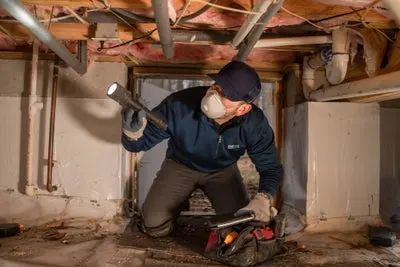
Crawl space inspections in Hampton Roads have a problem. A lot of what gets presented to homeowners as diagnostic testing is actually a sales tool — designed to create fear, justify a predetermined package recommendation, and close a deal. Here's what legitimate crawl space inspection actually looks like and what you should be skeptical of when someone gets under your home.
The Air Particle Test Scare Tactic
There's a specific company operating in Hampton Roads that uses an air particle counter as part of their inspection process. They present it as a mold test. Here's what it actually is.
An air particle counter measures particulates in the air — dust, debris, spores, anything airborne. In a vented crawl space that's been accumulating dust for decades that device is going to produce a high reading regardless of whether visible mold is present anywhere in the space. Dust reads as particles. Dirt reads as particles. A crawl space doesn't need a mold problem to generate a dramatic number on that device.
What I hear from homeowners multiple times every week is that this company told them their crawl space had one of the highest mold readings they'd ever seen. I then go into those same spaces and find no visible mold on the framing, no contamination on the insulation or ductwork, no evidence of a mold problem at all. What they had was a dusty vented crawl space — which describes most crawl spaces in Hampton Roads.
An air particle test used during an initial crawl space inspection is a red flag. There is no legitimate diagnostic use for that tool at that stage of an evaluation. The only appropriate use for air particle testing in a crawl space context is post-remediation clearance testing — verifying that a remediation was successful. Using it to generate scary numbers for a sales presentation is theater.
Why Moisture Meter Readings Can Be Misleading
Moisture meters have legitimate uses in crawl space evaluation but they're regularly misapplied in ways that produce misleading results.
Two specific problems:
Location matters enormously. Wood moisture levels vary significantly throughout a crawl space. The worst areas for moisture damage are typically above the ductwork where humidity concentrates in summer. If an inspector takes a moisture reading near the crawl space access door — often one of the drier spots in the space — they're not giving you an accurate picture of conditions across the entire crawl space.
Time of year matters enormously. Hampton Roads humidity drops to around 15% in winter. A crawl space with a severe summer mold and moisture problem will have relatively dry wood in January. A moisture meter taken in winter in a crawl space that floods with condensation every summer is going to produce a reading that doesn't reflect what actually happens beneath that home during the six months that matter most.
Moisture meters also give companies something to point to — a number that sounds objective and scientific. What they don't tell you is what those conditions look like in August when the real moisture load is present.
What Actually Tells the Story
A competent crawl space inspector doesn't need a particle counter or a moisture meter to tell what's happening beneath a home. The evidence is visible — and it tells the full story regardless of what time of year the inspection happens.
When I get into a crawl space I'm looking at:
The wood framing. Mold growth, staining, cupping, rot, and deflection are all visible. If moisture has been affecting that framing over years the evidence is there whether I'm inspecting in July or January. I probe wood to check for softness and deterioration where conditions suggest moisture damage.
The insulation. Moisture-damaged insulation shows it — staining, deterioration, mold growth, separation from the framing it's supposed to be insulating. Heavily contaminated insulation is not difficult to identify visually.
The ductwork. Older flex ductwork with mold growth on the insulation wrap is visible. Deteriorated duct connections are visible. These are the surfaces most likely to be affecting indoor air quality and they don't require a test to evaluate.
The ground and vapor barrier. Staining, deterioration, and evidence of standing water on an existing vapor barrier are all visible. A vapor barrier that's been sitting on wet ground leaves evidence.
The foundation walls. Water staining, efflorescence, and tide marks around the perimeter foundation wall tell you exactly what the groundwater history of that crawl space has been. If water has been getting in the wall shows it.
All of this gets photographed and documented. The homeowner sees exactly what I saw beneath their home — not a number on a device that can be calibrated to produce whatever result serves the sale.
Why Testing Serves the Inspector More Than the Homeowner
Moisture testing in winter gives a termite or pest control company cover to say they didn't see a moisture problem when they went under the home in February. Air particle testing gives a sales company a dramatic number to justify a package recommendation that was already decided before they opened the crawl space door.
Neither of those serves you. Both serve the company performing the test.
Real inspection is visual, documented, and explained to the homeowner with photographs. It identifies what's actually present, what's causing it, and what the space needs going forward — not what device reading can be used to close a deal.
What I'm Looking At When I Inspect
To be specific about the process: when I get under a home I evaluate the insulation condition, ductwork condition, wood framing surfaces, ground and vapor barrier condition, pipe surfaces, and foundation wall perimeter. I probe wood where conditions suggest deterioration. I photograph everything that's relevant to the diagnosis. I look for evidence of groundwater history even when water isn't actively present.
By the end of that evaluation I know what's wrong with the space, what's causing it, and what it needs. No particle counter required.
The Bottom Line
If a company is leading with a quick mold test or presenting moisture meter readings as the foundation of their diagnosis, ask them what that test is actually measuring and why it's necessary. The answer — or the inability to give one — tells you what kind of inspection you're actually getting.
A real inspection is visual, thorough, and documented. The diagnosis comes from what's actually present beneath your home — not from a device designed to generate a number that justifies a predetermined recommendation.
If you want to know what a straight inspection actually looks like, I'll come out personally and show you.
Proudly serving homeowners throughout Hampton Roads including Newport News, Yorktown, Poquoson, Hampton, Norfolk, Virginia Beach, Chesapeake, Suffolk, Williamsburg, Gloucester, and surrounding areas.
About The Author
Robbie McCarty is the owner of Patriot Crawl Space Repairs and a Virginia Class A Residential Building Contractor (DPOR #2705176108) and MICRO Certified Mold Remediation contractor with over 25 years of crawl space repair experience throughout Hampton Roads and coastal Virginia. He has personally evaluated and repaired thousands of crawl spaces beneath homes in Suffolk, Chesapeake, Virginia Beach, Norfolk, Newport News, Williamsburg, and surrounding communities.
