
Call Us Today To Schedule An Inspection At (757) 960-3231

Closed Crawl Spaces: Where the Building Code Got It Wrong
Watch The Full Video
Download The Technical Whitepaper (PDF)
Closed Crawl Spaces: Where the Building Code Got It Wrong
Closed crawl spaces are one of the biggest improvements in residential moisture control of the last twenty-five years. The researchers who figured out why vented crawl spaces fail in humid climates deserve the credit for that. But parts of the building code built on their work need another look, and the place it matters most is existing homes in the humid Southeast.
I’m Robbie McCarty. I own Patriot Crawl Space Repairs in Hampton Roads, Virginia. I’ve worked on low coastal crawl spaces for nearly thirty years and I personally inspect more than six hundred of them a year. This is what I see, and what the published research says about it.
What This Work Actually Is
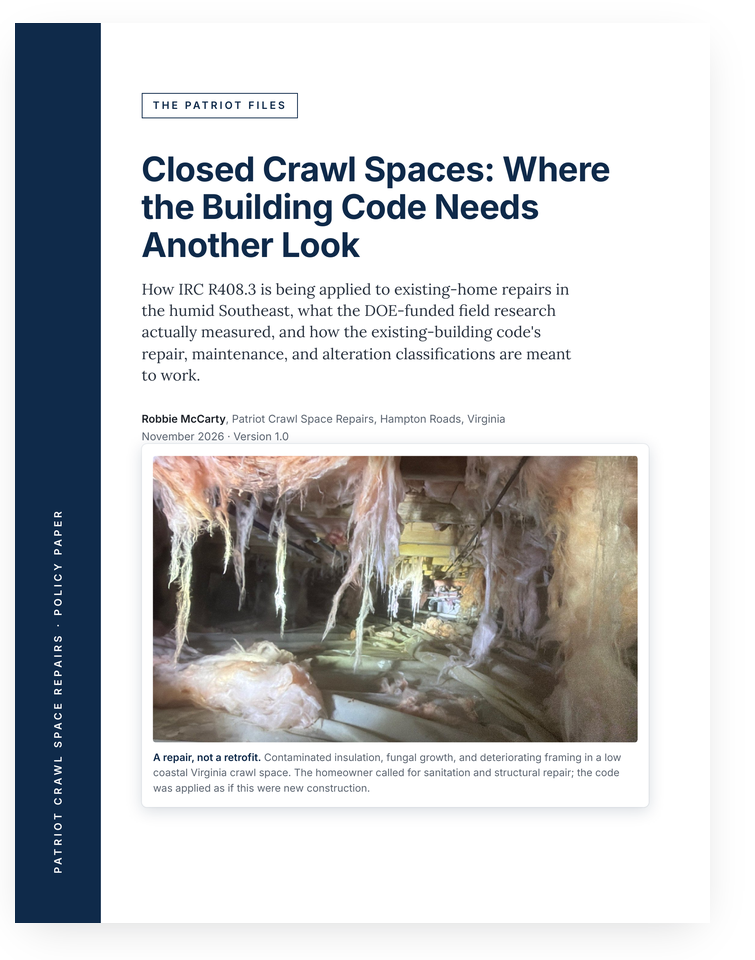
Most crawl space projects on existing homes are not energy upgrades. They are housing preservation: removing mold, rodents, and contaminated insulation, repairing rotted framing, and controlling moisture so the problem doesn’t come back. People close a crawl space in a humid climate to stop condensation, mold, and wood rot. That’s the job.
The homes are not neglected and they are not low-income. They’re middle-class houses whose owners can’t absorb an emergency $20,000 or $30,000 repair. An older homeowner with rodents under the house and mold on the framing. A military family that finds wet, infested insulation and joists starting to rot. Neither is trying to build a high-performance house. They’re trying to save the one they have.
When the price climbs too far, they do nothing. The mold stays, the rodents stay, the framing keeps rotting, and the house gets less safe, not more.
What the Code Requires
The International Residential Code covers unvented crawl spaces under R408.3. It requires a continuous ground vapor retarder with sealed seams, attached and sealed to the foundation walls; a drying method, meaning conditioned supply air with a return path or a dehumidifier; and foundation wall insulation. Those provisions were adopted in 2004. They are a clear checklist for new construction.
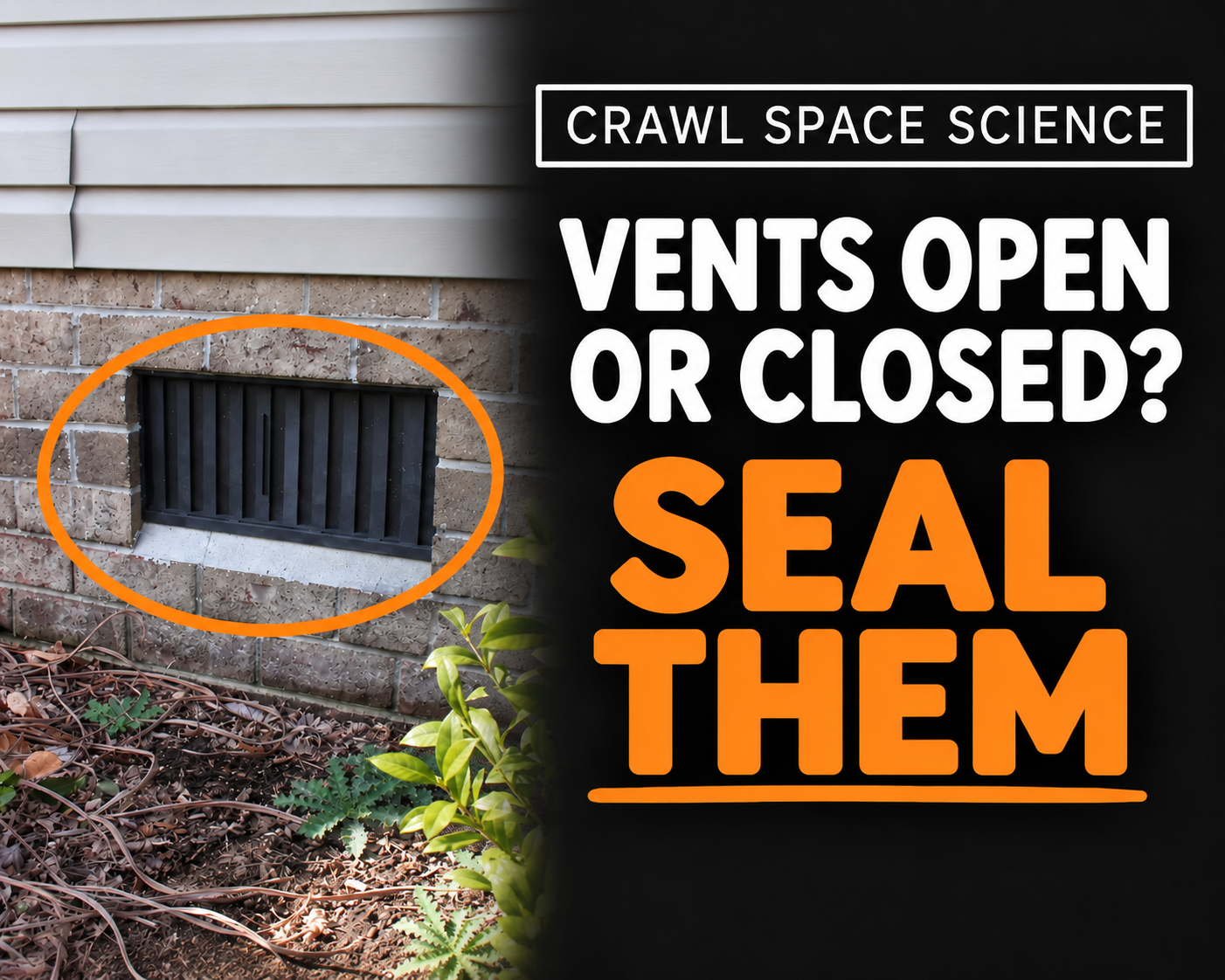
The problem is how they’re applied to existing homes. In many jurisdictions, sealing the foundation vents, laying a ground vapor barrier, or adding moisture control is classified as an alteration. That classification is then used to require the full new-construction assembly on what is a repair job. Ordinary sanitation and structural repair becomes a high-performance retrofit.
What the Research Showed
Beginning around 2000, Advanced Energy’s DOE-funded field work in North Carolina established that vented crawl spaces perform poorly in hot, humid conditions and that closed crawl spaces keep humidity and wood moisture lower. That finding is what led to the 2004 provisions.
But there’s a difference between establishing an approved method and proving every component of it is necessary. In Phase III of the same study (final report to DOE, June 22, 2005), researchers converted three vented crawl spaces to a simpler closed design: vents sealed, ground vapor retarder left unsealed with six to twelve inches of overlap, no wall liner, existing floor insulation left in place, 35 cfm of supply air.
At the August 2004 reading, those crawl spaces averaged about 11 percent wood moisture. The fully sealed designs averaged 10.4 to 10.7 percent. The remaining vented control averaged 14.5 percent. The report’s words: the simpler assembly “quickly exhibited performance similar to that of the other closed crawl space designs.”
Additional sealing lowered the air humidity somewhat. It did not produce a drier structure.
These Concerns Were Raised Early
In October 2004, a report prepared for HUD on building moisture research needs discussed the new IRC provisions directly: they were “intended to simplify the use of unventilated crawl spaces, yet the requirements are exacting and performance-oriented which will not facilitate their use.” It called for field testing “to identify the essential site, design, and construction details for acceptable performance.”
In 2005, Advanced Energy interviewed nine North Carolina closed crawl space installers for a second DOE project (final report January 2008). “Most noted that the cost of closed crawl spaces could be prohibitive for average homeowners.” One respondent warned of “overselling the system” when “the goal of this construction was simply to create a crawl space that was reliably dry.”
And in its own Southeast installation guide, Advanced Energy wrote that the North Carolina code “does not define a closed crawl space as requiring a sealed vapor retarder,” that “it is impractical to perfectly air-seal a crawl space,” and that it is “inappropriate to require code officials to use such a stringent, yet vague, standard for enforcement.”
Cost, complexity, and practicality were on the record from the start. The prescriptive details stayed the same anyway, and now they’re being applied to existing-home repairs.
Underneath a Real House
This work is needed from coastal Virginia around to Houston and up the Mississippi Delta. In these crawl spaces the foundation walls are two feet high, the winters are mild, and Oak Ridge National Laboratory’s own Builder’s Foundation Handbook recommends no wall insulation or at most R-5 for our heating-degree-day band. The savings are a few dollars a month. Air sealing solves the moisture problem and delivers most of the energy benefit by itself.
Covering the walls adds rodent harborage, blocks termite inspections and structural repairs, and costs thousands. Floor insulation isn’t a clean alternative: fiberglass between the joists becomes rodent nesting, hides the framing, and has to come out when it’s contaminated. What’s needed is a recognized path that leaves the walls and framing accessible when moisture control is in place.
North Carolina’s R409 already does this. Its ground vapor retarder provision requires joints lapped twelve inches, no sealing and no wall attachment; the sealed liner is permitted, not required. It lists five drying methods. The objective is a system that works for the house.
The Code Already Has the Tools
The existing-building framework distinguishes repair, maintenance, and alteration, and those classifications decide which requirements apply. Removing contamination and repairing damaged wood is repair. Sealing openings, controlling ground moisture, correcting drainage, and holding humidity down is maintenance. Installing materials does not make a project an alteration, and calling it “encapsulation” doesn’t establish a legal classification. Encapsulation is an industry term.
The International Property Maintenance Code already addresses grading and drainage, rodent harborage, foundation walls, and infestation. Those are the exact conditions we’re hired to correct. Virginia’s Existing Building Code says routine maintenance and ordinary repairs are not even subject to the repair chapter.
The first step is to determine what the homeowner is trying to accomplish and what work is necessary, then apply the provisions that govern that work. Don’t start from a new-construction specification and assume it governs everything under the house.
This isn’t a free pass. Regulated electrical, structural, plumbing, and mechanical work still requires permits. But the classification has to come first.
Getting it wrong has a cost. Virginia DHCD’s 2018 Resiliency Impact Analysis said it plainly: added cost “could be significant and prohibit owners from repairing the affected buildings... Any level of repair is better than no repairs at all.”
What Needs to Change
- Apply the existing-building repair and maintenance rules correctly. Classify the work before deciding which requirements apply. This is not a change to the code; it’s applying the code that exists.
- Where a project really is an alteration, review the national rules against the field research, including Advanced Energy’s simpler configurations.
- Separate the requirements needed for moisture control from the ones that are mainly for energy efficiency.
- Recognize different assemblies for different climates and existing homes, including a path for short, hot-humid coastal crawl spaces to stay without wall or floor insulation when moisture control is in place.
- Count installation and long-term cost, not just modeled energy savings: termite inspections, rodent exclusion, foundation maintenance, future structural repairs.
- Put the people who do this work at the table. Not corporate owners. The ones under the houses every day.
None of this abandons building science or lowers a legitimate safety standard. It asks whether the requirements fit the purpose and conditions of the project. In the coastal Southeast, crawl space work isn’t an exciting energy retrofit. It’s a housing preservation crisis.
If you’re a contractor, engineer, researcher, building official, or homeowner, I’d welcome your comments or additional research.
Patriot Crawl Space Repairs
Hampton Roads, Virginia
patriotcrawlspacerepairs.com
757-960-3231
Latest Crawl Space Articles