
Call Us Today To Schedule An Inspection At (757) 960-3231

Crawl Space Mold “Treatment” vs. Removal: Why the Mold Is Still There
Watch The Full Video
Download The Technical Whitepaper (PDF)
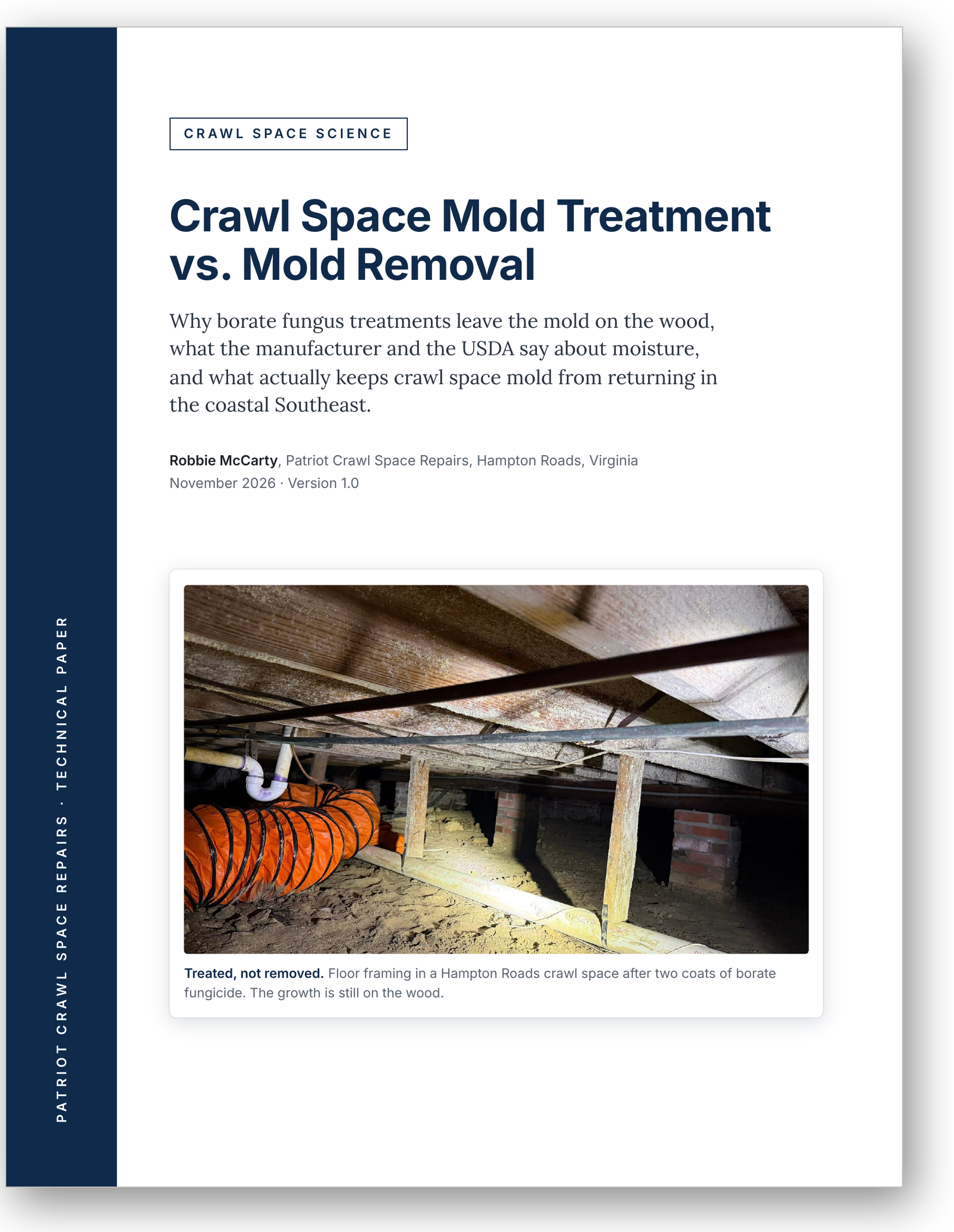
Crawl Space Mold Treatment or Fungus Treatment vs. Mold Removal: Why the Mold Is Still There
Homeowners in Hampton Roads spend thousands of dollars on crawl space mold treatments and fungus treatments, then crawl under the house the next summer and find the same growth on the wood. The reason is simple: most mold treatments don’t remove mold.
A mold treatment or fungus treatment sprays a chemical to kill or suppress fungal growth. Mold removal physically cleans the contamination off the framing, or replaces materials that can’t be cleaned. And neither one, by itself, corrects the moisture that allowed the mold to grow in the first place.
Treatment leaves the mold on the wood. Removal takes it off.
The shower test
Suppose you hired me to clean a shower that hadn’t been cleaned in ten years. Mold and mildew cover the tile and grout. I come in, spray everything with a chemical, collect my money, and leave. When you inspect the shower, all of it is still sitting there. You ask why I didn’t clean it, and I tell you, “I treated it.”
You’d think I was an idiot. You hired me to clean the shower, not spray something on it and leave the contamination behind.
If that sounds ridiculous in a shower, it should sound just as ridiculous in your crawl space.
Why physically removing mold matters
Killing mold doesn’t necessarily eliminate its health effects. The EPA’s guidance is direct: “Dead mold may still cause allergic reactions in some people, so it is not enough to simply kill the mold, it must also be removed.”
Mold spores and fungal fragments become airborne when contaminated material is disturbed, and those particles don’t stay in the crawl space. In research funded by HUD, Duke University and Advanced Energy documented fungal spores moving from crawl spaces into living areas through openings in the floor and leakage in HVAC systems.
How common is mold in Southeast crawl spaces?
In 2005, Advanced Energy investigated 45 vented crawl spaces in North Carolina as part of a larger Duke University study funded by HUD. Researchers found visible mold in 62 percent of them. Sixty-seven percent had wood moisture readings high enough to support mold growth. Humidity monitoring through the summer showed 100 percent of June and July readings at or above 70 percent relative humidity, and 99 percent in August.
The mechanism is predictable. Warm, humid outside air enters a cooler crawl space through the foundation vents, humidity climbs, and water condenses on cool framing and ductwork. That’s why mold is so common in vented crawl spaces across the coastal Southeast. The moisture is predictable, so the mold is too.
What crawl space fungus treatments actually are
Three common products are Tim-bor Professional, Bora-Care, and Bora-Care with Mold-Care. These are legitimate products with legitimate uses. They contain borate compounds that protect wood against decay fungi, termites, and other wood-destroying organisms, and they’re used in new construction, for preventive protection, and on existing structures.
But their purpose is not to physically clean mold-covered framing, and they don’t eliminate the need for moisture control.
What the manufacturer says
Nisus Corporation’s 2020 Mold and Fungi Technical Bulletin opens its discussion of fungal growth with the heading “Moisture Is the Key to Fungal Control.” The bulletin states that fungi need wood above 20 percent moisture content or air above 80 percent relative humidity.
The bulletin acknowledges that chemical treatment can protect wet building materials while they dry, which may take weeks or months. That’s a legitimate use after flooding or serious water intrusion.
But under post-construction treatments, Nisus directs applicators that “all moisture problems should be fully rectified.” And on page 7: “It is not possible for any product to provide permanent protection of a structure that remains continuously wet.”
Borates wash out of wet wood
Borates are water-soluble. The USDA Forest Products Laboratory’s Wood Handbook says it plainly: “Borate preservatives are readily soluble in water and highly leachable and should be used only above ground where the wood is protected from wetting.” On spray-applied borates specifically: “because they are not fixed to the wood they can be leached during subsequent precipitation.”
In my experience, when a damp Southeast crawl space gets a fungus treatment without correcting the moisture, growth returns within six months to a year. I’ve personally seen it happen after two coats. The chemical suppressed the growth for a while. The conditions that caused it never changed.
How we actually clean crawl space mold
At Patriot, we start with YCS Pro Cleaner, a professional hydrogen peroxide-based cleaning solution. The concentrate is 17 percent hydrogen peroxide, compared with about 3 percent in household peroxide. It produces no harsh gases or odors and is effective on organic contamination like mold.
We allow 30 to 60 minutes of dwell time per the product’s application requirements, then hand-wipe the remaining fungal material off the framing. The result is wood that looks close to new. Some water staining or discoloration may remain, but staining alone doesn’t mean active mold is present.
Not everything in a crawl space can be cleaned. Wood framing and other accessible solid surfaces can generally be cleaned when the material is structurally sound. Metal ductwork can often be cleaned if the contamination is accessible. Fiberglass insulation and fibrous duct liners are different. You can’t wipe fungal contamination out of those materials. When they’re significantly contaminated, removal and replacement is the right call.
Why mold removal costs more than a fungus treatment
For a typical 1,500-square-foot crawl space in our market, a chemical-only fungus treatment might run around $1,200. Our physical mold cleaning typically runs around $2,800.
That’s not because cleaning requires mysterious technology. It’s because physically cleaning framing in a two-foot-high crawl space, crawling around ductwork, plumbing, piers, and other obstructions, is hard labor. Spraying is easy. Cleaning is labor.
What about bleach?
Bleach is the first thing a lot of homeowners reach for. The EPA doesn’t recommend bleach or other biocides as a routine part of mold cleanup. The goal is to remove the mold, not just kill it. And like any other chemical, bleach does nothing about the moisture that caused the growth.
Does every crawl space with mold need an expensive cleaning?
No. If we find significant fungal growth, we require cleaning as part of our project; we won’t put our name on a job where substantial contamination is left behind. If the growth is minor, we explain the options and let the homeowner decide. If there’s barely any visible growth, we tell them an expensive cleaning isn’t needed.
We’re not trying to make a crawl space sterile. That’s impossible. We’re trying to remove meaningful contamination, correct the moisture, and prevent new growth.
What about mold testing?
If I walk into a shower covered in visible mold, I don’t need a lab test to establish that it needs cleaning. The same applies to a crawl space with obvious growth. The EPA’s guidance: “In most cases, if visible mold growth is present, sampling is unnecessary.”
An airborne particle counter doesn’t identify mold either. It counts particles that could be dust, pollen, fibers, or anything else.
Different people are sensitive to different fungi, and crawl spaces commonly contain a mixture, so we don’t spend much time identifying which species is on each joist. Our concern is how much contamination there is, whether it can be cleaned, and whether the moisture has been corrected.
Testing is useful when contamination is hidden, the source is uncertain, or a specialized investigation is needed. When the problem is plainly visible, you need an inspection and a corrective plan, not an expensive test to confirm what you can already see.
What keeps crawl space mold from coming back
Moisture control. In the coastal Southeast, that means managing groundwater where necessary, sealing the foundation vents, installing a ground vapor barrier, and providing a reliable drying mechanism, either conditioned supply air or a dedicated dehumidifier, depending on the house.
Then we verify it by monitoring wood moisture content. In properly controlled crawl spaces we typically see averages around 11 percent, with summer highs of 13 to 15 percent. Our target is 16 percent or below, even in the worst of the humid summer.
When those conditions are maintained, properly cleaned framing doesn’t develop new growth, and we generally don’t apply an additional fungicide. Once the moisture is corrected, we aren’t relying on chemicals to suppress mold. We’re maintaining conditions that won’t support it.
Four questions to ask any crawl space contractor
- Are they physically cleaning the framing, or just spraying it?
- What happens to contaminated insulation or ductwork?
- How will they keep the crawl space dry in July and August?
- Will they measure the wood moisture afterward to prove it’s working?
If a contractor can’t give you clear answers, you’re probably looking at a treatment, not a remediation.
The bottom line
A chemical treatment suppresses mold. Cleaning removes it. Moisture control keeps it from coming back.
A $1,200 fungus treatment and a $2,800 mold cleaning aren’t the same service, and neither one replaces proper moisture control.
Robbie McCarty is the owner of Patriot Crawl Space Repairs in Hampton Roads, Virginia, and personally inspects more than 600 crawl spaces a year. Call 757-960-3231 or visit patriotcrawlspacerepairs.com.
Sources
- EPA, A Brief Guide to Mold, Moisture and Your Home. https://www.epa.gov/mold/brief-guide-mold-moisture-and-your-home
- Kirker, G.T., and Lebow, S.T. 2021. “Wood Preservatives,” Chapter 15 in Wood Handbook: Wood as an Engineering Material, FPL-GTR-282. USDA Forest Service, Forest Products Laboratory. https://research.fs.usda.gov/fpl/wood-handbook
- Nisus Corporation, Mold and Fungi Technical Bulletin, 2020.
- Advanced Energy / Duke University, HUD-funded crawl space study, North Carolina, 2005.
Latest Crawl Space Articles