Call Us Today To Schedule An Inspection At (757) 960-3231

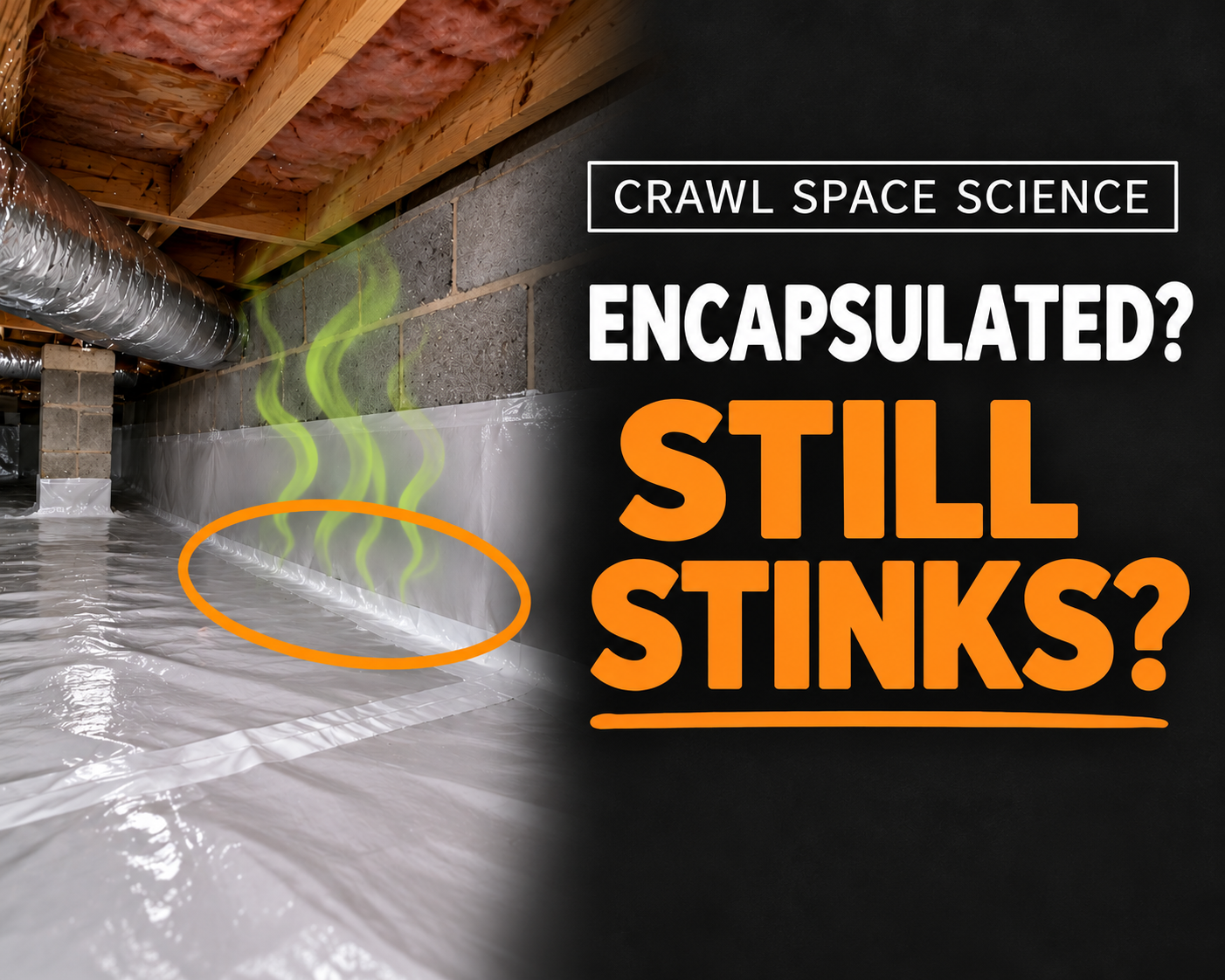
Crawl Space Encapsulation: Is All That Plastic Necessary?
Watch The Full Video
Download The Technical Whitepaper (PDF)

Crawl Space Encapsulation: Is All That Plastic Necessary?
How did we get to the point where we wrap every surface under a house in plastic? Tape every seam, wrap every pier, cover every foundation wall, then sell the homeowner a $15,000 to $30,000 encapsulation system and call it the Cadillac of crawl spaces.
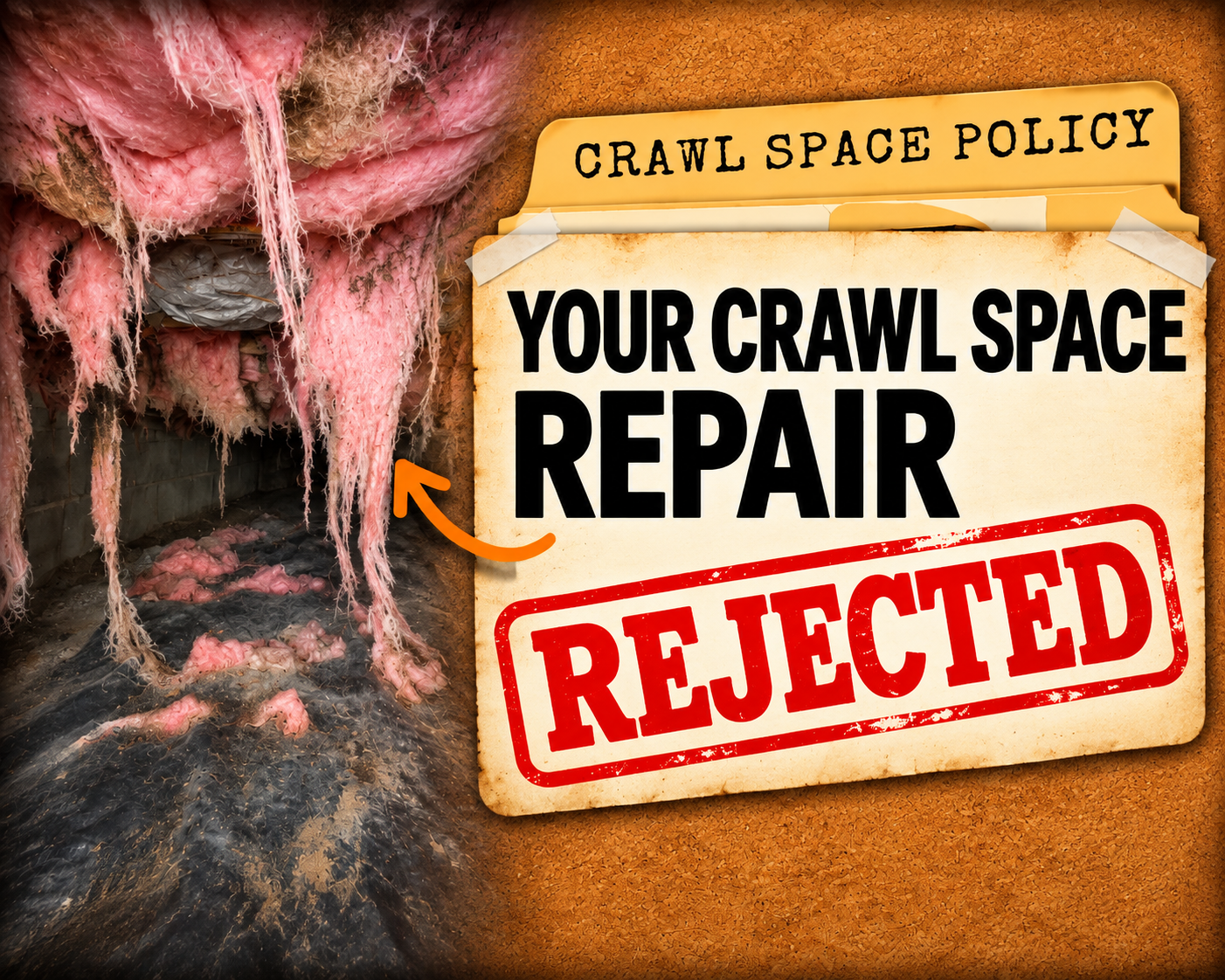
Here's what a lot of those Cadillacs look like a few years later: rodents chewed through the plastic, droppings everywhere, ductwork destroyed, tape peeling off the walls. Now the homeowner is facing another expensive repair.
So forget the sales pitch and ask one question: does all that extra plastic actually keep the structural wood any drier?
I'm Robbie McCarty, owner of Patriot Crawl Space Repairs in Hampton Roads, Virginia. I've worked in residential construction, real estate, inspections and repairs for nearly 30 years, and I personally inspect more than 600 crawl spaces a year. I'm a Virginia Class A contractor, licensed pest control operator, certified mold remediator and master plumber. I don't just see installation photos. I see what works, what fails and what gets torn out years later.
Where Crawl Space Moisture Comes From
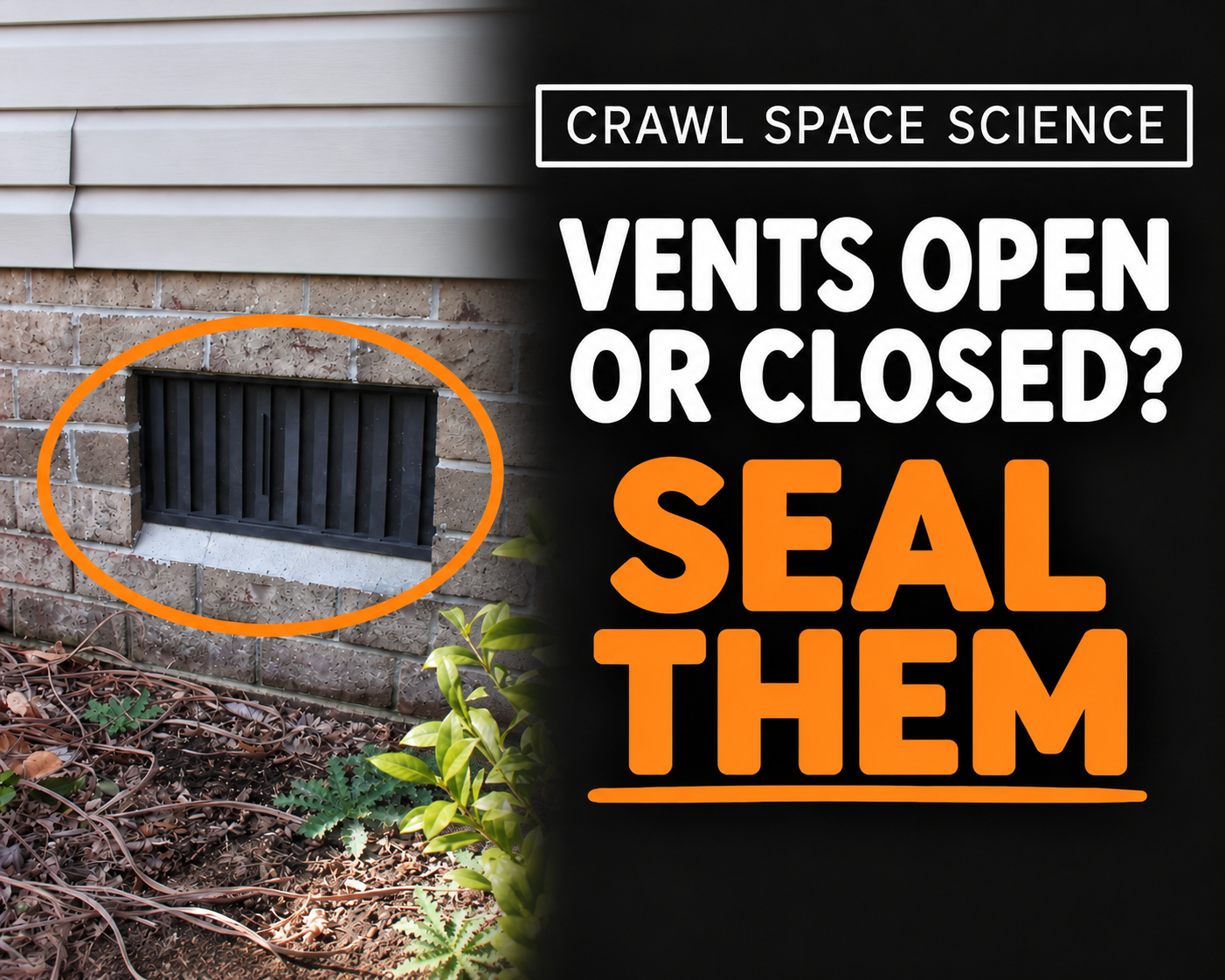
In vented crawl spaces across coastal Virginia and the humid Southeast, a major moisture source is hot, humid summer air coming in through the foundation vents. That air has a high dew point. When it hits cooler framing, ducts or pipes below that dew point, it condenses.
Moisture also evaporates from the soil. And some homes have a different problem entirely: bulk groundwater coming in after rain. Different causes need different repairs:
- Humid air: seal the exterior air openings.
- Soil evaporation: cover the soil.
- What's left: provide drying with conditioned supply air or a dehumidifier.
- Water coming in: fix the drainage. Don't confuse water intrusion with humidity.
What a Closed Crawl Space Actually Needs
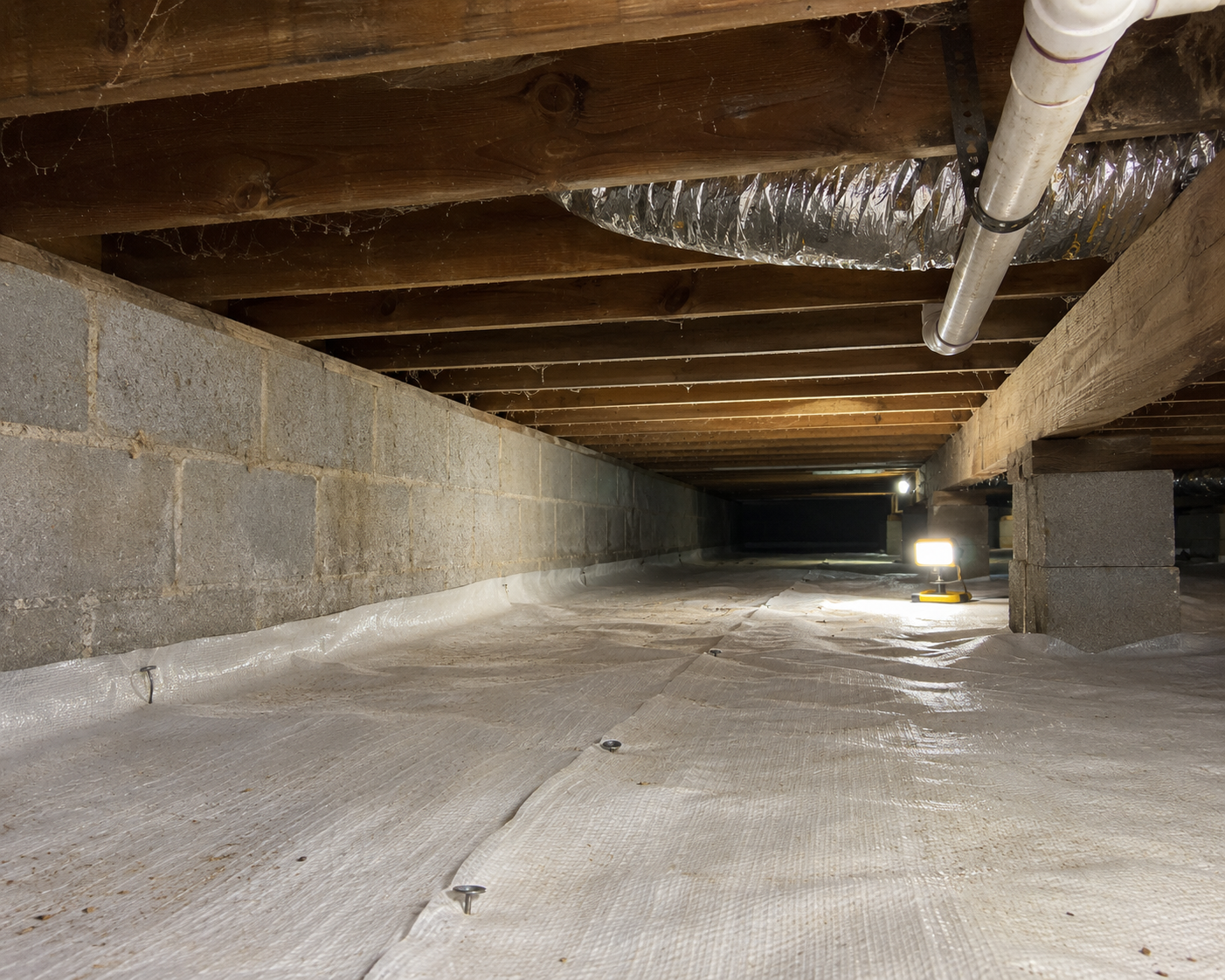
I'm not telling you to throw plastic on the ground, close the vents and pray. A closed crawl space needs three things working together: air sealing, a good ground vapor barrier and a reliable way to dry the air. If you have groundwater, you fix the drainage too.
That's the system. The real question is whether taping every seam, wrapping every pier and covering every foundation wall adds enough benefit to justify the cost.
What the Vapor Barrier Actually Does
The ground barrier slows the rate of soil evaporation. That's its job. We're not trying to dry every grain of dirt or stop every molecule of vapor. We're cutting the daily moisture load enough to keep the wood dry.
Cover 1,500 square feet of soil with a durable 12 mil woven barrier, overlapped and pinned, and you've covered nearly all of the exposed ground. Sure, some moisture may move around untaped seams and edges. But how much? Enough to make the dehumidifier work substantially harder? Enough to raise wood moisture?
If someone makes that claim, ask for the measurements. And if the ground stays wet, tape isn't the answer. Drainage is.
What the Research Shows
Advanced Energy studied closed crawl spaces in North Carolina more than 20 years ago for the U.S. Department of Energy. In the Phase III field trials, three vented control homes were converted by sealing the vents and adding a crawl space supply duct, without sealing the ground vapor retarder or installing any wall vapor retarder. According to the report, those homes "quickly exhibited performance similar to that of the other closed crawl space designs."
Here's the structural wood moisture from the report's Figure 50, comparing the sealed-liner homes with the no-wall-liner homes. Both groups were closed crawl spaces with R-19 floor insulation.
Sealed liner + wall liner
- Average wood moisture: 10.7%
- Maximum wood moisture: 12.6%
No wall liner, seams not sealed
- Average wood moisture: 11.0%
- Maximum wood moisture: 12.4%
Values read from Figure 50, p. 88, single reading in early August 2004; accurate to about 0.1%.
Does a little more moisture get through the unsealed edges and seams? Probably. But in those test homes it made no meaningful difference to the wood. The wood stayed dry, and that's the scorecard. Not how shiny the plastic looks or how many seams somebody taped. The moisture content of the wood.
The study doesn't prove sealing never helps. It shows that more sealing wasn't necessary to get comparable wood moisture in those test homes. That's a big difference from claiming everybody needs the complete package.
I've discussed this with some of the top crawl space building scientists in the country, including researchers involved in the original field studies. Not one has refuted it, and most have told me they suspect I'm probably right about these low coastal crawl spaces. If anyone has research showing that a properly drained crawl space with sealed vents, an overlapped ground barrier and adequate drying needs a fully sealed liner to keep the wood dry, I'd genuinely like to see it.
Why Wrap Piers and Cover Walls?
Over the last 20 years I've talked with more than a hundred home inspectors, termite professionals, building officials and experienced contractors about crawl space moisture control. They know moisture has to be controlled. They also know that simple ground barriers, sealed vents, proper drying and drainage when needed have worked around here for decades. In all those conversations, I haven't found one who thought the extra plastic was necessary, or who'd put it under their own coastal Virginia home.
A 20-inch-high crawl space isn't a finished basement. It has block walls, masonry piers, ductwork, plumbing and very little room to move. If a wall gets a little damp after rain, that moisture can evaporate into the crawl space; the question is whether it's enough to affect the wood. If water is actually coming through, fix the drainage. Don't cover the evidence.
Then there's the physical reality. Concrete block isn't smooth. There are mortar joints, pier ridges, penetrations, tape joints and fasteners. I've seen pier wraps you can put your hand behind because of the block edges, and I've never inspected a fully encapsulated crawl space with no gaps anywhere. As these systems age, connections loosen, rodents chew through plastic and tradespeople disturb it during repairs. A thick liner doesn't guarantee a permanent seal.
Meanwhile, covered walls hide termite tubes, cracks, rodent entry points and water intrusion. This is a service space. Something will eventually need repair, so why make every trade's job harder and more expensive? Preserve access to the foundation wherever the design allows.
The One Exception: Radon and Soil Gases
If testing shows a soil-gas problem, a properly sealed membrane with sub-membrane depressurization may be needed. That's a specific mitigation design, not an argument for wrapping every coastal crawl space in plastic.
What the Extra Plastic Costs
In a typical 1,500-square-foot coastal crawl space with about 20 inches of clearance:
- Pinned 12 mil woven vapor barrier (Patriot): $2,800
- Sealed liner with taped seams, covered walls and wrapped piers: $7,500
- Bigger encapsulation liner plus wall insulation: $12,000
- Complete package (drainage, rodent exclusion, insulation, mechanical drying): $25,000 to $30,000
That's $4,700 more, almost three times the price, for the liner work alone. And don't compare that with a four-foot mountain crawl space where you can move around. Here we're squeezing under plumbing and ductwork on our stomachs. It's slow work.
Both systems can be damaged. Rodents can contaminate them, and a drainage repair may mean pulling them out. But a pinned barrier is cheaper to pull back, repair or replace. If you've got $2,800 in plastic and your neighbor has $12,000, which loss would you rather take when the plumber or drainage crew comes through?
None of this is a reason to skip needed repairs. It's a reason to make sure every component earns its keep.
Building Code vs. Repair
Before anyone quotes the new construction code, understand the difference between building a house and repairing one. IRC Section R408.3 gives prescriptive requirements for new closed crawl spaces, including a Class I vapor retarder with joints sealed or taped. Existing-home repair is a different activity with its own provisions. First determine what work is being done and why; that tells you how it's classified. Don't assume a new-construction assembly is automatically the repair prescription.
Think of a slightly musty basement. Would you excavate to the footings, tear up the slab, install a whole new drainage system and spend $160,000 because that's how you'd build a new basement? Of course not. You'd diagnose the moisture source and start with a reasonable repair. Crawl spaces shouldn't be any different.
What I'd Put Under My Own House
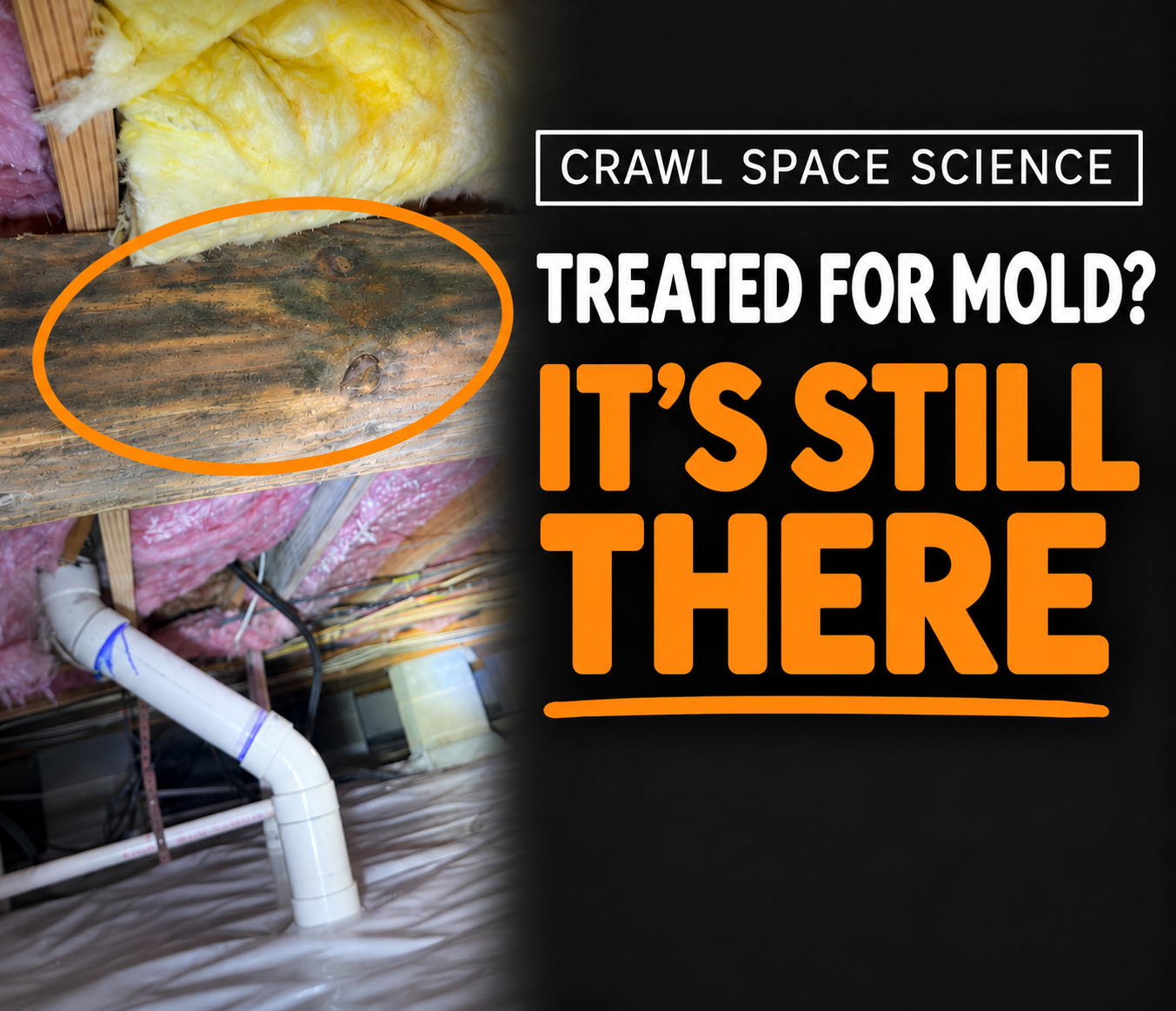
- Clean contaminated framing.
- Repair or replace musty or failing ductwork.
- Fix any known drainage problems.
- Do a thorough job of rodent exclusion, including proper screening at entry points.
- Seal the outside air openings.
- Install a durable pinned ground vapor barrier.
- Use conditioned supply air or a properly sized dehumidifier.
Then monitor temperature, humidity, dew point and structural wood moisture. We generally see average wood moisture around 10 to 11%. We want summer readings around 12 to 13%, and 16% is the upper limit where we'd investigate. If another problem shows up, diagnose it and fix it. Keep the system accessible and easy to change.
Before You Sign an Encapsulation Contract
Don't buy pretty installation pictures. Hire someone who has actually repaired houses, who can find the moisture source and explain the simplest fix likely to work. If someone tells you their plastic and wall foam is the Cadillac of crawl spaces, show them the door. You're hiring someone to fix a moisture problem, not shopping for a luxury car.
For each component, not the whole system, ask two questions:
- What does this cost me?
- What happens if I don't install it?
Whether it's a salesperson, engineer, building scientist or building official recommending it, ask for the measurable benefit. We're trying to keep the wood dry, not build a NASA spacecraft under your house. Make every component earn its keep.
Questions about your crawl space? Contact Patriot Crawl Space Repairs in Hampton Roads, Virginia.
Research and Sources
- Advanced Energy, A Field Study Comparison of the Energy and Moisture Performance Characteristics of Ventilated Versus Sealed Crawl Spaces in the South, final report to the U.S.
- Department of Energy, June 2005, p. 88 and Figure 50. Full report (PDF)
- U.S. Department of Energy, Unvented Conditioned Crawlspaces: Building America Top Innovation
- International Code Council, International Residential Code, Chapter 4, Section R408.3 Unvented Crawl Space
Latest Crawl Space Articles