
Hampton Roads Crawl Space Journal
Expert field notes on crawl space moisture, structure, and building performance from 25 years beneath coastal Virginia homes
Is Crawl Space Insulation Necessary In A Closed Crawl Space?
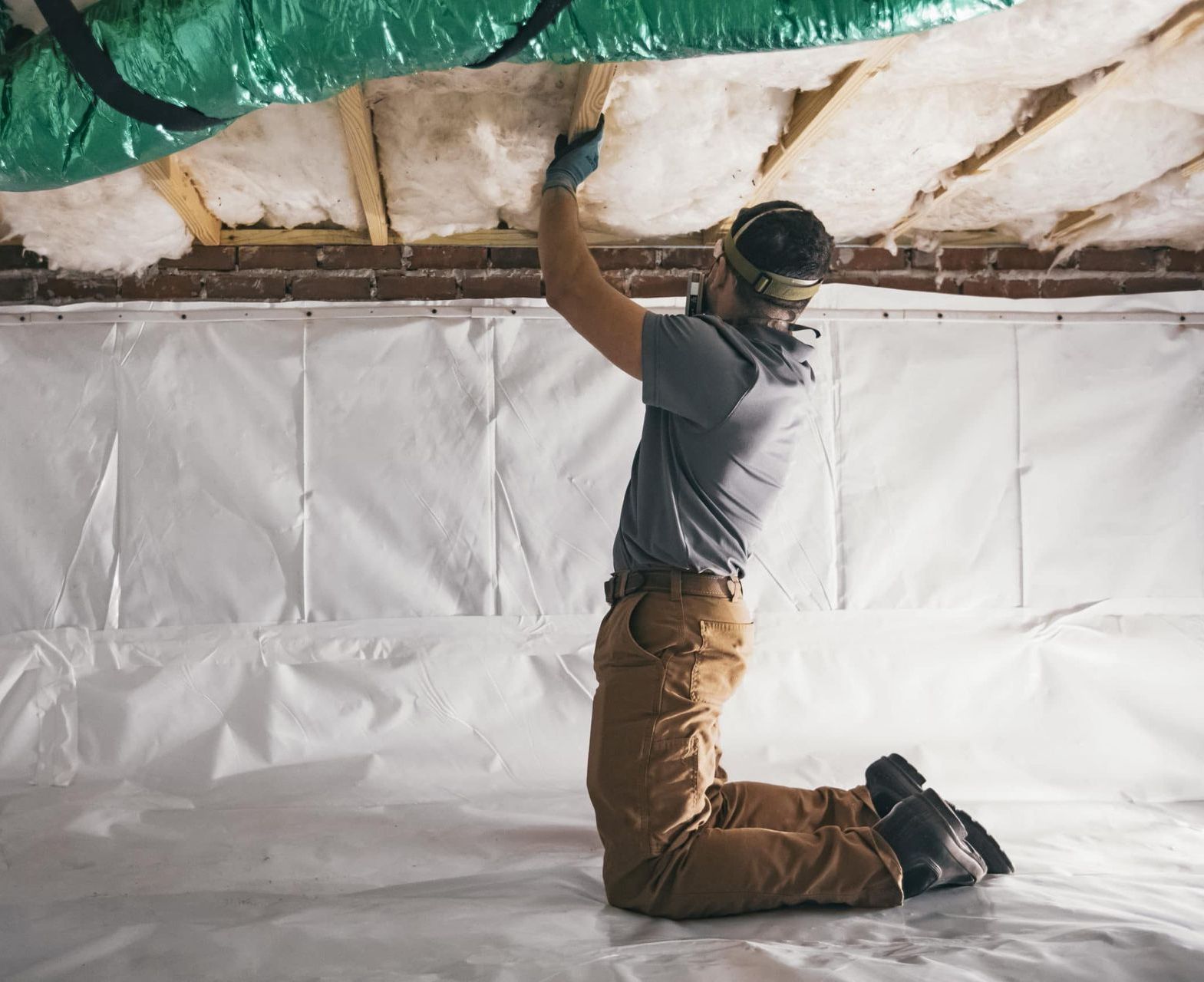
Is Crawl Space Insulation Necessary in a Closed Crawl Space?
By Robbie McCarty — Virginia Class A Contractor & Crawl Space Specialist
One of the most common assumptions in crawl-space work is that if insulation was installed beneath the floor when the house was built, it must always be replaced when it is removed.
In Coastal Virginia, I do not think that is true.
A properly closed crawl space behaves very differently from a traditional vented crawl space. Once the foundation vents and other major outside-air openings are sealed, the crawl space becomes much more thermally connected to the house above it and much less connected to outdoor conditions.
That changes the insulation question completely.
In my experience, a properly closed crawl space in Coastal Virginia generally does not need floor insulation or foundation-wall insulation to remain comfortable, dry, or reasonably energy efficient.
The building-science data supports that, the energy-code treatment of Climate Zone 3A supports it, and hundreds of crawl spaces we have worked in support it in the field.
What Is A Closed Crawl Space?
A closed crawl space is essentially a crawl space where the foundation vents, crawl-space door, and other major outside-air openings have been sealed to stop uncontrolled outdoor-air intrusion.
That is the important change.
In a vented crawl space, the crawl space behaves much more like the outdoors. In summer, hot humid air enters through the vents. In winter, cold outdoor air moves beneath the floor system.
Once those openings are sealed, the crawl space starts interacting much more closely with the conditioned home above it.
That is why you cannot look at the insulation requirements of a traditional vented crawl space and assume they apply the same way to a properly closed one.
What Does An Uninsulated Closed Crawl Space Actually Feel Like?
There are two ways I look at this question.
The first is simply what happens in the field.
The second is what the energy studies and thermal modeling show.
The best time to understand the field side is during temperature extremes.
In Coastal Virginia, that might mean a winter day around 20°F or a summer day around 95°F.
When I enter a properly closed crawl space with no floor or wall insulation on a very cold day, it feels surprisingly warm. It does not feel like crawling outdoors. It feels much more like entering an interior part of the house.
The same thing happens in summer.
Open the crawl-space door on a 95°F day and the space often feels cool immediately.
If you work in one all day, the difference is obvious. A properly closed crawl space feels much more like working indoors than underneath an outdoor structure.
That field experience makes sense once you look at the energy data.
What Do The Energy Studies Say?
We have enough field research and energy modeling to estimate what crawl-space insulation actually contributes.
Advanced Energy, working with the U.S. Department of Energy, studied closed crawl spaces and found them to be roughly 15% to 18% more energy efficient than traditional vented crawl spaces with R-19 floor insulation.
Those closed crawl spaces did include foundation-wall insulation.
The next question is obvious:
How much of that energy benefit came from the wall insulation, and how much came from simply closing the crawl space?
The available Department of Energy research gives us a good answer.
Air Sealing Provides Most Of The Energy Benefit
The Builder's Foundation Handbook, developed through Oak Ridge National Laboratory and the U.S. Department of Energy, allows us to estimate the energy contribution of the foundation-wall insulation itself.
Based on that work, wall insulation represents only about 2.5 percentage points of the energy benefit seen in the closed-crawl research.
So if closing the crawl space creates roughly a 15% energy improvement compared with a vented crawl space with floor insulation, and wall insulation accounts for approximately 2.5%, an uninsulated closed crawl space would still be roughly 12.5% more energy efficient than the traditional vented crawl space with R-19 insulation beneath the floor.
That tells us something important.
The majority of the energy improvement is coming from air sealing, not insulation.
That is consistent with whole-home energy modeling in general.
Controlling uncontrolled air movement usually matters a lot.
Adding insulation to a surface with relatively little heat transfer matters much less.
How Much Does Wall Insulation Actually Change Crawl Space Temperature?
Oak Ridge National Laboratory has also modeled the temperature difference between closed crawl spaces with and without foundation-wall insulation.
The difference is surprisingly small.
The modeling shows only about a 1.5°F difference in the middle of winter, with very little meaningful difference during summer conditions.
It also shows that relatively little total energy is being lost through the foundation walls of a closed crawl space.
Again, that matches what I see in the field.
If removing foundation-wall insulation caused a dramatic thermal penalty, I would expect an uninsulated closed crawl space to feel cold in January.
It does not.
What Does The Energy Code Say?
Most state energy codes, including Virginia's, are based on versions of the International Energy Conservation Code, or IECC.
The IECC contains an R-value table specifying insulation requirements for closed crawl-space foundation walls.
Climate matters.
In Climate Zone 3A, the crawl-space wall insulation requirement is exempted.
That is important for Coastal Virginia.
Climate Zone 3A includes the Southside Hampton Roads cities, Western Tidewater, and extends north through Newport News under the applicable climate-zone framework.
ASHRAE's 2025 climate-zone updates also place James City County, Williamsburg, York County, and Poquoson in Climate Zone 3A.
So effectively, the energy-code climate classifications themselves recognize that crawl-space wall insulation is not generally necessary throughout Hampton Roads.
As you move farther north toward Richmond, you move into Climate Zone 4A, where the code treatment changes and wall insulation requirements become more relevant.
The same pattern continues nationally.
Crawl-space wall insulation is generally not required by the IECC in Climate Zones 1, 2, and 3A, while colder climate zones have more insulation requirements.
There was some confusion about the Climate Zone 3A treatment in the 2021 energy code because of an error in the insulation table, but that issue has since been clarified. Here is a link to that clarification: Climate Zone 3A IECC Correction
Existing Homes Are Different From New Construction
Energy-code requirements are only part of the discussion.
The other important issue is that most crawl-space remediation is happening in existing homes, not new construction.
To understand how existing-building codes treat this work, you have to understand why the existing-building code was developed in the first place.
In the mid-2000s, the International Code Council significantly developed the repair and alteration framework for existing buildings.
The purpose was straightforward.
Existing homeowners should not automatically be forced into additional unrelated upgrades every time they perform necessary repair or maintenance.
If repairing one bad condition automatically triggered an entire package of new-construction requirements, homeowners would often defer the repair completely.
That leads to further building deterioration.
The philosophy behind the existing-building framework was essentially that some repair is better than no repair and that additional work should generally not be imposed on a repair project unless there is a serious safety reason to do so.
Virginia adopted that basic repair-and-alteration framework into the Virginia Existing Building Code.
Repair And Alteration Are Not The Same Thing
The definitions matter.
Under the existing-building framework, repairs are work performed to maintain a building or correct damage.
Maintenance prevents a bad condition.
Repair corrects a bad condition.
An alteration is work other than a repair or an addition.
That distinction is important because crawl-space remediation is generally being performed for exactly those repair and maintenance purposes.
The homeowner has mold, moisture, damaged insulation, condensation, rodents, wood deterioration, or another bad condition.
The work is being performed to correct that condition or prevent it from recurring.
That is fundamentally repair and maintenance work.
Does Removing Old Crawl Space Insulation Require Installing New Insulation?
I do not see anything in the Virginia Existing Building Code that says removing contaminated crawl-space insulation automatically requires installation of new insulation.
This issue has been disputed.
The Virginia Technical Review Board was specifically asked to address this question and did not issue a ruling establishing that removed insulation must automatically be replaced.
I was present for that hearing and participated as the primary technical witness on the crawl-space issue.
That does not mean the board formally ruled that replacement is never required.
It means the question was not resolved in a way that created a clear enforceable replacement mandate.
If you call many local building departments and ask whether insulation needs to be replaced after removal, you may receive a conservative answer that it does.
That is different from the actual text of the existing-building code automatically requiring it.
Why Building Departments And Existing-Building Codes Sometimes Clash
There is a practical reason this becomes confusing.
Existing-building codes are difficult to administer.
Every existing home is different.
They were built in different eras, under different codes, with different repairs, additions, site conditions, and materials.
That does not fit neatly into a checklist.
Building departments need processes that can be applied consistently by inspectors, plan reviewers, and administrative staff.
The easiest administrative answer is often to classify work as an alteration and apply a known new-construction template.
That is understandable from an administrative standpoint.
But it is not necessarily the same thing as the purpose-based repair framework actually written into the existing-building code.
The existing-building code intentionally creates more flexibility because existing homes cannot always be treated like new construction.
Why I Usually Remove Old Crawl Space Insulation
If there were no good reason to remove the insulation, I would agree with leaving it alone.
But that is usually not the situation we encounter.
Traditional crawl-space fiberglass has often spent years or decades exposed to summer moisture.
It may have been damp every summer and dried during winter for 20 or 30 years.
Once you close the crawl space, that old insulation can release a moldy or mildew odor.
The easiest comparison is a pile of towels that repeatedly got wet and then dried out.
They may be dry today.
That does not mean you want them beneath your house.
Old Insulation Can Hide More Than Moisture
There is also no practical way to know everything that has happened inside decades-old fiberglass.
Rodents may have nested in it.
Insects may have occupied it.
Snakes may have used it.
Termite activity may be hidden behind it.
Wood deterioration may be concealed above it.
If we are cleaning a crawl space, removing mold and fungus, sealing the space, and trying to create a clean, inspectable environment, my view is that contaminated old fiberglass usually does not belong in that finished system.
Removing it is better for the house, better for sanitation, and better for long-term maintenance.
Inspectability Matters
One of the biggest benefits of removing floor insulation is that the framing becomes visible.
You can see the joists.
You can see the subfloor.
You can see plumbing leaks.
You can see termite activity.
You can see rodent activity.
You can see wood deterioration and future moisture problems before they become major repairs.
That visibility has real value.
Saving a very small amount of energy while hiding the structural floor system behind old fiberglass is not necessarily a good trade in a warm-humid coastal environment.
What Will Home Inspectors And Termite Inspectors Say?
In Coastal Virginia, most home inspectors, termite inspectors, and real estate professionals I deal with are not particularly enthusiastic about crawl-space insulation.
They have seen the same problems I have.
They see insulation trapping or concealing moisture.
They see mold.
They see termite activity hidden behind fiberglass.
They see rodents nesting in it.
They see damaged insulation falling from the joists.
The small energy benefit has to be weighed against those practical problems.
In colder or higher-elevation regions, inspectors may have a different view because the thermal conditions are different.
But in Coastal Virginia, an uninsulated closed crawl space is not unusual or inherently alarming to people who regularly inspect these homes.
What About Future Home Buyers?
Home buyers are less predictable.
Many buyers today understand why insulation is removed from closed crawl spaces because they have seen mold, rot, rodents, or termite problems in previous homes.
Others may arrive with different assumptions.
Someone from a much colder climate may think an uninsulated crawl space sounds strange.
Someone heavily focused on energy efficiency may assume more insulation is always better.
Someone may have been told by a relative that the plumbing will freeze without fiberglass under the floor.
You cannot predict every future buyer's assumptions.
What you can do is maintain a crawl space that is dry, clean, inspectable, and demonstrably performing well.
That usually tells a much stronger story than leaving questionable old insulation in place simply because someone might ask about it later.
When Should Existing Crawl Space Insulation Stay?
There are situations where I leave floor insulation in place.
If the insulation is relatively new, clean, dry, properly installed, and in excellent condition, there may be no compelling reason to remove it.
The decision should be based on the actual condition of the material.
The problem is that insulation meeting that description is not what we usually encounter during crawl-space remediation.
Most insulation being considered for removal is already wet, moldy, fallen, contaminated, damaged, or decades old.
When Should New Insulation Be Installed?
In Coastal Virginia, I generally would not reinstall crawl-space insulation simply because insulation was removed.
I would consider adding insulation for a few specific reasons.
The first is if the property is located in a jurisdiction that actually enforces a requirement for it.
I distinguish that from simply receiving a conservative answer from a permit desk when someone calls and asks the question. Keep in mind that an informal phone answer by a permit desk is simply a guidance opinion, not a formal code interpretation for your property or situation.
So not do they say insulation is required if you ask them, do they actually enforce it for your property type and applicable situation. A reputable contractor can tell you that.
The second reason would be actual comfort performance.
If a homeowner notices cold perimeter floors or another measurable comfort issue after the crawl space is closed, insulation can always be added strategically.
That situation is rare in my experience.
If You Insulate A Closed Crawl Space, Where Should It Go?
If someone insists on insulating a closed crawl space in Coastal Virginia, my first choice would generally be the rim joist and band-board area.
That is where the floor system meets the exterior foundation and where colder perimeter conditions are most likely to occur.
Strategic insulation there can address an actual thermal weak point without covering the entire floor system.
If foundation-wall insulation is required by the applicable code or an enforcing jurisdiction, then wall insulation would be the next logical location.
I generally would not reinstall fiberglass beneath the entire floor in a properly closed crawl space unless there were unusual circumstances.
Will My Floors Be Cold Without Crawl Space Insulation?
We have removed crawl-space insulation and closed hundreds of crawl spaces.
I cannot remember a homeowner coming back afterward and telling me their floors became noticeably cold because the fiberglass was removed.
That makes sense.
A properly closed crawl space in Coastal Virginia commonly stays in the low 60s during winter.
The floor system is no longer sitting directly above 20°F or 30°F outdoor air moving through foundation vents.
It is sitting above a relatively mild closed environment.
That is why the thermal experience changes so much after the crawl space is sealed.
Will My Pipes Freeze Without Crawl Space Insulation?
Floor insulation has essentially nothing to do with protecting the crawl-space plumbing from freezing.
In a traditional vented crawl space, the plumbing is generally located below the floor insulation.
That means the pipes were already outside the insulated floor envelope.
The fiberglass above the pipes was not what kept them from freezing.
Heat did.
Once the crawl space is closed, winter crawl-space temperatures in Coastal Virginia typically remain far above freezing.
A crawl space in the low 60s cannot freeze the plumbing.
If a house is abandoned during winter with the heat completely shut off, plumbing can freeze regardless of what insulation is installed.
Insulation does not create heat.
It only slows heat transfer.
Conclusion: Is Crawl Space Insulation Necessary?
In a properly closed crawl space in Coastal Virginia, my answer is generally no.
The field experience says it.
The energy modeling says the thermal penalty is small.
Department of Energy research shows that most of the energy improvement from closing a crawl space comes from controlling air movement rather than from foundation-wall insulation.
The International Energy Conservation Code's Climate Zone 3A treatment reflects the same basic reality by exempting crawl-space wall insulation in that climate zone.
And from a practical standpoint, removing old floor insulation improves sanitation, visibility, termite inspection, rodent inspection, and long-term maintenance.
That does not mean insulation is useless everywhere.
In colder climates and higher elevations, the calculation changes.
There may also be individual homes where rim-joist insulation, foundation-wall insulation, or another targeted insulation strategy provides a measurable comfort benefit.
But crawl-space insulation should be treated as a tool, not a requirement of nature.
In Coastal Virginia, I would rather have a dry, closed, clean, inspectable crawl space with no insulation than a crawl space filled with old fiberglass simply because someone assumes more insulation must always be better.
The building should be judged by how it actually performs.
IECC Zone 3A Insulation R-Value Table Correction
Advanced Energy Closed Crawl Space Study
Oak Ridge Crawl Space Modeling
Virginia Existing Building Code
