
Hampton Roads Crawl Space Journal
Expert field notes on crawl space moisture, structure, and building performance from 25 years beneath coastal Virginia homes
Pinned Vapor Barrier vs. Fully Sealed Liner: When Is Each the Right Choice?
Pinned Vapor Barrier vs. Fully Sealed Liner: When Is Each the Right Choice?
By Robbie McCarty — Virginia Class A Contractor & Crawl Space Specialist
A lot of homeowners are told that more plastic means a better crawl space.
That sounds logical, but that is not how engineering works.
A fully sealed liner is not automatically better than a pinned ground vapor barrier. They are different tools for different site conditions, and the right choice depends on the crawl space, the soil, the terrain, the clearance, the pest risk, the water risk, and what the homeowner actually needs the space to do.
The goal is not to install the most expensive or most finished-looking system possible.
The goal is to install the right system for the house.
A Crawl Space System Should Match The Site Conditions
When I crawl into a space, I am not asking, “How much plastic can I install?”
I am looking at the site.
What kind of soil is under the house? Is the property flat or sloped? How much clearance is there? Is water likely to move across the ground? Are termites a major concern? Is radon an issue in that region? Is this crawl space ever going to be used for storage?
Those questions matter much more than whether one system looks more finished than another.
In low coastal crawl spaces with sandy or sandy-loam soils, relatively flat lots, low clearance, and low radon risk, a pinned vapor barrier is often exactly the tool I want.
In that environment, foundation-wall water intrusion and runoff across clay are usually not the main threats. Radon is typically less of a concern than it is farther inland.
The major long-term threats are often termites, rodents, moisture, flooding, and the general difficulty of maintaining a low crawl space.
That changes the design priorities.
When A Pinned Vapor Barrier Makes More Sense
A pinned liner gives you flexibility.
It is easier to install, easier to inspect around, cheaper to repair, and easier to modify later if the crawl space develops a drainage problem.
You can still inspect the foundation walls. Pest-control companies can still access the wall-to-ground connection. If a rodent tears part of the liner, one section can be repaired without rebuilding the entire system.
If drainage conditions change later, you can see what is happening and adapt.
That matters in low coastal crawl spaces because those environments can be unpredictable.
A crawl may look dry when the system is installed and develop a groundwater problem years later. A severe storm may create flooding that the homeowner has never seen before. Rodents may damage materials. Termites may show up.
The simpler system is easier to maintain when one of those things happens.
And from a moisture-management standpoint, a properly installed pinned ground vapor barrier can perform extremely well.
Most Crawl Space Moisture Was Never Coming From The Ground
One of the biggest misunderstandings in crawl-space work is the belief that the ground is the dominant moisture source.
In many humid-climate crawl spaces, it is not.
The major moisture load historically came from warm, humid outdoor air entering through foundation vents and other openings.
Once those vents and openings are sealed, the moisture load changes dramatically.
A ground vapor barrier covering roughly 99% of the soil already eliminates almost all of the ground-vapor contribution. The remaining exposed soil area represents a very small moisture load compared with the moisture loads affecting the house as a whole.
That is why gluing the liner to every inch of the foundation wall often adds very little practical moisture-control benefit in these conditions.
The moisture problem is not usually that last one percent of exposed soil.
The bigger issue was outside air entering the crawl space.
Advanced Energy And U.S. Department Of Energy Field Studies Support The Simpler Approach
Advanced Energy, working with the U.S. Department of Energy, performed field studies comparing closed crawl spaces using sealed liners with crawl spaces using ground-pinned vapor barriers.
The humidity and wood-moisture results were very similar between the approaches.
Those systems relied on conditioned supply air, which is a more passive moisture-control method than the dedicated crawl-space dehumidifiers commonly used today.
If you take that same basic ground-pinned system and add something like an Aprilaire E100 dehumidifier, the remaining moisture load is relatively easy to handle.
You may spend slightly more in dehumidifier runtime, but that small operating cost can buy a lot of flexibility, inspectability, and long-term maintainability.
That is often a good trade.
When A Fully Sealed Liner Is The Better Tool
There are absolutely crawl spaces where I prefer a fully sealed liner.
The clearest example is a taller crawl space on a sloped site with clay soil.
In those conditions, water may move across the ground or down the hill beneath the house.
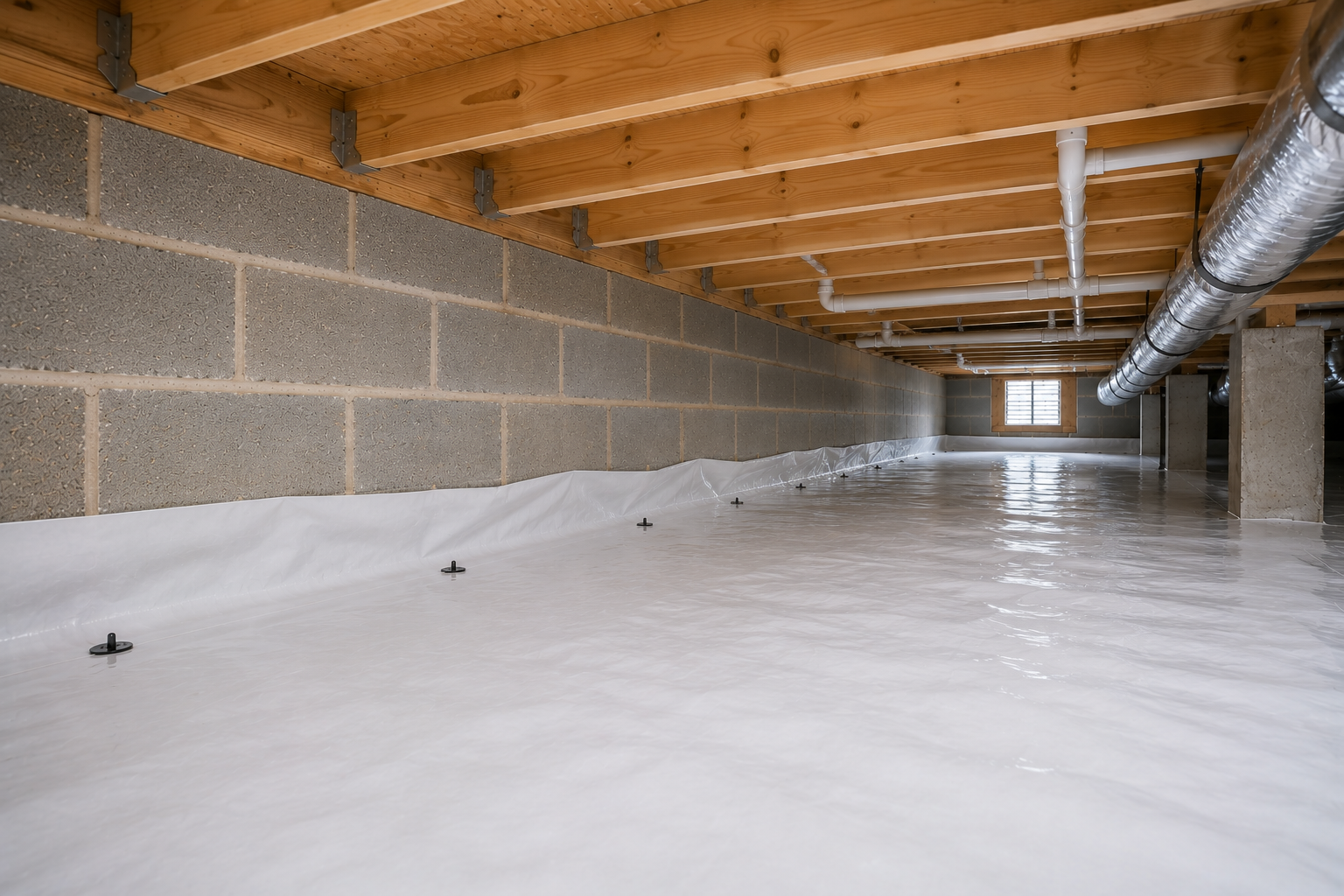
A sealed liner can be used as part of the drainage strategy by directing water beneath the liner toward a lower drainage point without allowing that water to flow across the top surface.
That is a legitimate reason to seal the walls.
These crawl spaces also tend to have more clearance, which changes the economics and maintenance issues.
A tall crawl space is easier to work in, easier to inspect, and easier to repair. The added labor required to install and maintain a sealed wall liner is not nearly as painful as it is in a 20-inch-high coastal crawl.
The space may also be useful.
Homeowners may store kayaks, bicycles, seasonal items, or other equipment there. In those situations, a thicker liner and a more finished system may be worth the money simply because the crawl space is functioning as usable storage.
I have even installed outdoor carpet over portions of heavy liners in tall crawl spaces where durability and usability mattered.
That is a completely different application from a low coastal crawl that nobody wants to enter unless something needs to be repaired.
Radon Is Another Legitimate Reason For A Sealed System
Radon risk also changes the calculation.
In inland, hill, and mountain regions, radon is generally more relevant than it is in many coastal areas.
A sealed liner can be an important component of a radon-control strategy.
Again, that does not make a sealed liner universally better.
It means there is a specific site condition that gives the sealed system a real job to do.
That is how these decisions should be made.
Fully Sealed Liners Have Real Tradeoffs
The problem is that many contractors present a fully sealed liner as an upgrade with no downside.
There are downsides.
In a low-clearance crawl space, installation labor is much more expensive. The liner is harder to inspect around. Repairs are more difficult. Rodent damage can be harder and more expensive to correct. Termite inspection and treatment become more complicated.
Variable water tables can also create surprises.
A crawl may appear completely dry when the liner is installed and later develop water intrusion that was never anticipated.
Coastal flooding can create similar problems.
In a harsh, low-clearance coastal crawl space, an expensive fully sealed liner can become a liability if it is damaged or if site conditions change.
You have created a more complicated system in an environment where simplicity and repairability may matter more than small gains in theoretical moisture optimization.
Termite Inspectability Matters
This is one of the biggest reasons I prefer simpler systems in many coastal crawl spaces.
The U.S. Department of Agriculture has historically recommended maintaining inspectability at foundation walls and access to the wall-to-ground connection for termite inspection and treatment.
Pest-control operators understand why that matters.
The crawl-space encapsulation market, however, became heavily influenced by general contractors and waterproofing companies that did not always come from a pest-control background.
Somewhere along the way, termite inspectability became treated like an inconvenience instead of a design requirement worth protecting.
That makes no sense to me.
Saving a few dollars a month in dehumidifier runtime is not worth sacrificing long-term termite visibility unless there is a real reason to cover that wall.
If the wall needs to be sealed because of runoff, drainage, radon, or another specific site condition, then fine.
But giving up inspectability simply because “more sealed” sounds better is poor system design.
Optimization Is Not The Same Thing As Durability
A useful way to think about this is the difference between optimization and durability.
If you want the lightest, fastest car possible, you are probably not building the most durable vehicle possible.
The same principle applies here.
A fully sealed liner may create a slightly more optimized moisture-control system on day one.
That does not automatically mean it is the better system three years later, five years later, or ten years later.
In a low coastal crawl space with rodents, termites, possible flooding, changing drainage conditions, and extremely difficult access, I do not want a Ferrari.
I want a Toyota Land Cruiser.
I want a system that can take abuse, remain inspectable, be repaired inexpensively, and continue doing the job for a long time.
Crawl-space work is not cosmetic remodeling.
It is home maintenance.
The system should be simple, durable, affordable, and appropriate for the actual risks present at the property.
A More Finished Crawl Space Is Not Always A Better Crawl Space
One reason fully sealed liners sell so well is that they look impressive.
The walls are covered. Everything is bright and clean. The crawl space looks finished.
But appearance and engineering performance are not the same thing.
A sealed liner can be the right choice in a tall crawl space where the owner wants usable storage, where runoff needs to be managed beneath the liner, or where radon control is important.
In those situations, the more finished system provides real benefits.
But in a low coastal crawl space, that same system may increase cost, reduce pest inspectability, complicate maintenance, and create expensive repair problems without meaningfully improving moisture control.
That is not an upgrade.
It is simply the wrong tool for that application.
Use The Right Tool For The Crawl Space
There is no single crawl-space system that is best for every house.
A pinned vapor barrier is often the better choice in low, flat, coastal crawl spaces where the primary concerns are humidity, pests, inspectability, durability, and future repairability.
A fully sealed wall liner makes more sense when the liner has an additional job to do—such as directing runoff in a sloped clay crawl space, supporting radon mitigation, or creating a more usable finished space in a tall crawl.
The mistake is assuming that more material automatically means better engineering.
It does not.
A hammer may be more satisfying to swing than a screwdriver, but that does not make it the right tool for every job.
The same principle applies beneath a house.
The right crawl-space system is the one that solves the actual problems present at that property while creating the fewest unnecessary long-term problems of its own.
Learn More About Crawl Space Encapsulation:
Hampton Roads Crawl Space Encapsulation
Do I Really Need A Full Encapsulation
Sealed Vs. Pinned Vapor Barrier Field Study Summary
