
Hampton Roads Crawl Space Journal
Expert field notes on crawl space moisture, structure, and building performance from 25 years beneath coastal Virginia homes
When Does Crawl Space Ductwork Need To Be Replaced?
When Does Crawl Space Ductwork Need To Be Replaced?
By Robbie McCarty - Virginia Class A Contractor & Crawl Space Specialist
Crawl space ductwork does not last forever, especially in a crawl space that has had moisture, mold, or rodent problems for years.
When I inspect ductwork, I don't start by looking only at the ducts. I look at the crawl space as a whole.
Is there mold or fungus on the joists? Is the crawl space insulation moldy or deteriorated? Is there evidence that the crawl space has had a long-term moisture problem? How old does the ductwork appear to be?
Those conditions tell me a lot about what has probably happened to the duct insulation over time.
The Condition Of The Crawl Space Tells You A Lot About The Ductwork
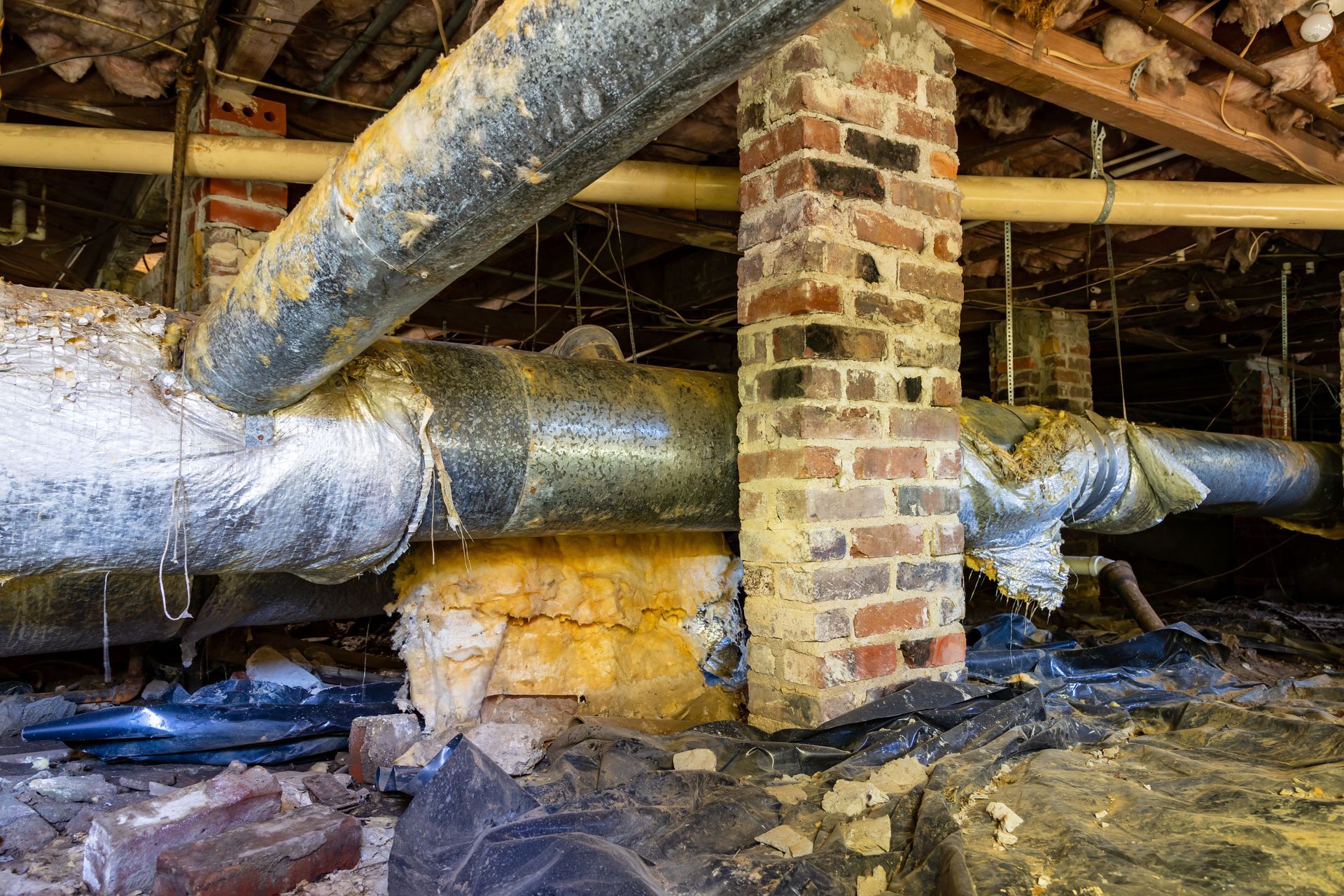
If the joists and crawl space insulation are covered with mold and fungus, there is a good chance the duct insulation has been exposed to the same conditions.
I look closely at the seams in the duct insulation and around the supply boots where the branch lines connect. Those areas often show mold or deterioration first.
I also look for staining that appears to be bleeding through the outer foil jacket. When moisture, mold, and deterioration are working their way through the insulation far enough that you can see evidence on the outside, that tells you something about what has been happening inside that material.
Then I look for obvious physical damage, deteriorated sections, disconnected ductwork, and rodent activity.
.
One thing I pay particular attention to is rodent droppings on top of the trunk line. Rodents like to travel and sometimes nest around ductwork, so droppings there can be a pretty strong indication that they have been spending time around the system.
Think Of Duct Insulation Like Upholstery
The easiest way I know to explain old crawl space duct insulation is to compare it to upholstery.
Imagine you owned a convertible with cloth seats.
Every summer you left the top down and allowed those seats to get damp. Then every winter you dried them back out.
Now imagine you did that every summer for 30 years.
What do you think those cloth seats would look and smell like?
Crawl space duct insulation is also a fibrous material. In a crawl space with a recurring summer moisture problem, that insulation can go through the same basic cycle year after year.
It gets exposed to high humidity and condensation during the summer, dries during other parts of the year, and then goes through the cycle again the following summer.
After decades of that, mold and mildew can become established in the insulation.
And this isn't just another material sitting in the crawl space.
This insulation is wrapped around the duct system carrying the air that enters your home.
That's usually when I ask the homeowner a very simple question:
If the duct insulation has been wet and moldy repeatedly for decades, and all of the air entering your home is traveling through that duct system, do you really want to clean everything else in the crawl space and leave the old moldy ductwork?
Most people say no.
Age Matters More When Moisture Is Present
I don't replace ductwork simply because it reaches a certain birthday.
Condition matters.
But age combined with moisture matters a lot.
If a duct system is more than about 30 years old and the crawl space has had a significant moisture problem, it usually needs serious consideration for replacement.
On the other hand, a house that is only 10 or 20 years old with a gradual moisture issue may have ductwork that is still in reasonably good condition.
That's why there isn't a precise formula.
You have to look at the crawl space, the history of the moisture problem, and the actual condition of the ductwork.
Moldy Duct Insulation Cannot Simply Be Wiped Clean
One of the biggest problems with duct insulation is that it is fibrous.
You can clean a hard surface.
You cannot realistically wipe mold and mildew out of old fibrous insulation the same way you would clean framing or sheet metal.
Moisture and condensation can also deteriorate the tape and sealing materials around seams. Once those materials begin breaking down, moldy or deteriorated insulation can start affecting the duct system itself.
That is why severe duct contamination is primarily a sanitation issue to me.
It isn't about whether we can patch one more seam or squeeze another five years out of an old piece of ductwork.
The question is whether the material is something you still want surrounding the air-distribution system in your home.
Rodent Activity Changes The Decision Quickly
Rodent contamination makes me much more likely to recommend replacement.
If I see rodent activity around the ductwork, physical damage, and droppings on the ducts, I generally believe the affected ductwork should be replaced.
The problem is that you cannot always know where the rodents have been.
They may have nested in the duct insulation or traveled through areas that cannot be seen from the outside.
Cleaning the visible surface doesn't necessarily tell you what is inside that insulation.
So when there is meaningful rodent activity combined with damage or contamination, I generally don't consider surface cleaning enough.
Not Every Duct System Needs To Be Replaced
There are plenty of situations where the ductwork can stay.
If the duct insulation looks good, there is very little mold or mildew, the seams are intact, the foil jackets are in good condition, and there isn't significant rodent activity, I don't see a reason to replace it just because we're doing other crawl space work.
Sometimes the crawl space insulation needs to come out while the ductwork can remain.
In those cases, I may recommend that the homeowner have the ductwork professionally cleaned instead.
There is also a middle ground.
Sometimes the ductwork isn't obviously bad enough that I can say it unquestionably needs to go, but it isn't perfect either.
When that happens, I tell the homeowner exactly that.
It is not an exact science.
If the ductwork is marginal, I explain what I see and tell them that cleaning or replacement are both reasonable options.
How I Decide Whether Crawl Space Ductwork Should Stay
My basic rule is pretty simple.
If the crawl space has a mold problem and I see significant mold affecting the ductwork, or if there is meaningful rodent activity and contamination around the ducts, I generally believe the affected ductwork needs to go.
If those conditions are not present and the ductwork is still in good physical condition, it can usually stay.
If it falls somewhere in the middle, I give the homeowner the truth about where I think it falls on the spectrum and let them make the decision.
The goal isn't to replace ductwork simply because it is old.
The goal is to avoid cleaning and repairing an entire crawl space while leaving behind one of the largest potentially contaminated materials in the space.
Learn More About Crawl Space Ductwork Services
Get A Free Ductwork Inspection
Ductwork Repair And Replacement
