
Hampton Roads Crawl Space Journal
Expert field notes on crawl space moisture, structure, and building performance from 25 years beneath coastal Virginia homes

Why We Recommend the Minimum Effective Dose for Crawl Space Moisture Control
When people hear the phrase minimum effective dose, they sometimes assume it means doing the cheapest possible job or cutting corners. That is not what it means. The minimum effective dose means identifying every real problem beneath the home and solving those problems with the simplest, most durable, most affordable system that actually works.
The idea comes from the KISS principle: Keep It Simple, Stupid. The phrase is commonly associated with Clarence “Kelly” Johnson and Lockheed’s Skunk Works, where systems were designed to be repairable in the field with simple tools under difficult conditions. That is very close to how I think crawl-space systems should be designed.
The First Step Is Understanding What Actually Needs To Be Solved
Before choosing products, you have to identify the real failures. Where is the moisture coming from, and what else is being affected—mold, ductwork, rodents, structure, insulation, drainage? The minimum effective dose does not mean solving fewer problems; it means solving all of the real problems without adding unnecessary work that does not materially improve the outcome.
More Material Does Not Automatically Mean A Better Crawl Space
There is a tendency in crawl-space work to assume that more is better: more plastic, more insulation, more drainage, more dehumidification, more supports. But every added component comes with cost, maintenance, failure points, and tradeoffs. If a component does not solve a real problem at that particular house, the question should be simple: why are we installing it?
Overbuilding Happens For A Lot Of Reasons
There are commercial incentives behind larger crawl-space systems because more materials generally mean larger average tickets, and manufacturers naturally benefit when more products are included in standard assemblies. Industry research, conferences, training programs, and media are also often supported by manufacturer sponsorship, which does not mean there is a conspiracy to oversell crawl spaces, but it does mean more material-heavy systems can receive more attention.
A lot of contractors and salespeople also simply sell what the industry has taught them to sell. They may not be dishonest at all; they are selling a package they have been told represents best practice and may never have stopped to ask whether every component is necessary at every house.
Mainstream Practice Can Become A Template Instead Of A Diagnosis
Once an assembly becomes the industry standard, it tends to spread through contractors, manufacturers, inspectors, and code officials until the template becomes familiar simply because everyone recognizes it. That does not necessarily mean every component is needed for every property. A crawl space is not a product package; it is an existing part of a building with its own climate, soil, drainage, pest, structural, and maintenance conditions.
Overbuilding Creates Real Long-Term Tradeoffs
The downside of overbuilding is not just the initial price. More complex systems can reduce access for termite inspection, make rodent damage harder to repair, hide foundation cracks, conceal water intrusion, complicate future drainage work, and increase maintenance costs. If we are going to give up inspectability or increase long-term repair cost, there should be a good reason for doing it.
Every Added Component Should Solve A Specific Failure
Suppose water runs downhill across a sloped clay crawl space and gets on top of a ground liner. That may be a legitimate reason to install a wall-sealed liner, or perhaps a French drain at the high point solves the problem more simply. If radon is a concern or certain foundation walls consistently take on water, additional sealing may be justified, but the important question is always the same: what failure are we preventing?
Simple Solutions Are Often More Durable
Engineering is full of tradeoffs between optimization and durability. A Ferrari has tighter tolerances and higher maximum performance than a Honda Accord, but the Honda is generally far more tolerant of neglect, abuse, and long-term daily use. Crawl-space systems behave the same way: the more optimized and complex a system becomes, the more maintenance-sensitive it often becomes.
Dehumidifiers And Supply Air Show The Tradeoff Clearly
A dedicated dehumidifier gives very precise control over relative humidity and is an excellent moisture-control tool when it is operating correctly. But it also requires drainage, electricity, maintenance, filters, and eventual replacement. A supply air inducer is less precise, but it is extremely simple and operates whenever the HVAC system operates, so the tradeoff is higher maximum control versus simplicity and reliability.
Fully Sealed Liners Also Show The Tradeoff
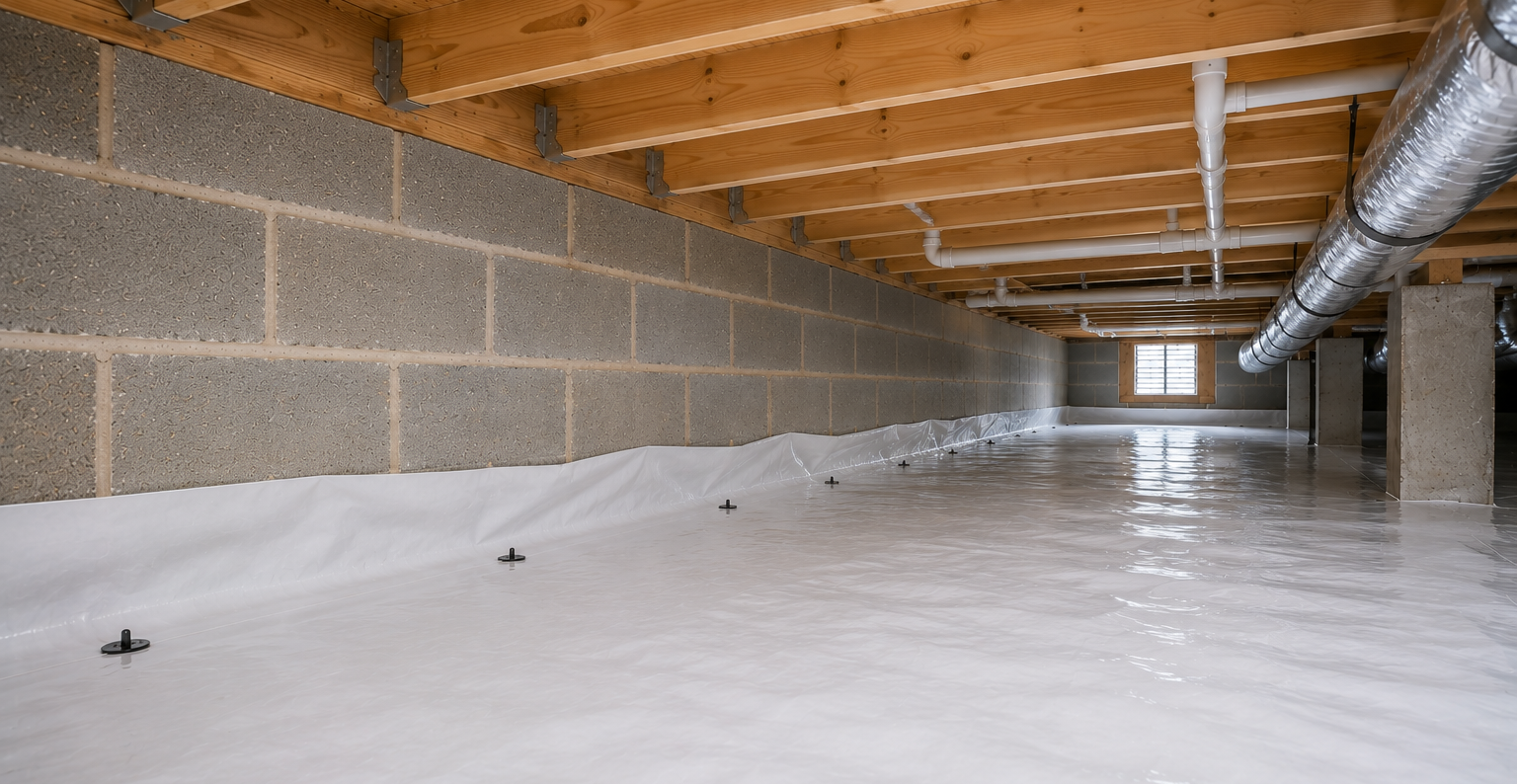
A fully sealed liner with wall insulation can maximize moisture and energy control on installation day, but that added material can make termite inspection, rodent repair, drainage evaluation, and future maintenance more difficult. A pinned vapor barrier may be less visually dramatic, but in the right low coastal crawl space it can actually be the more durable and practical system. That is why a pinned liner should not be viewed as a downgrade.
The Minimum Effective Dose Is About Solving All The Real Problems
Affordability matters because homeowners rarely have only one issue beneath the house. They may need mold cleaning, moisture control, new ductwork, rodent repairs, insulation removal, or structural repair all at the same time. If you overspend on one component, you may leave another real problem untreated.
A Less Expensive Moisture-Control Method Can Free Money For A More Important Repair
Suppose a crawl space needs mold cleaning, moisture control, and duct replacement, but the homeowner cannot afford all of that plus a several-thousand-dollar dehumidifier system. If the site conditions are appropriate, we may seal the vents and air openings, install a pinned vapor barrier, and use a supply air inducer instead. The money saved on the dehumidifier can then be used to replace moldy or damaged ductwork, which may be the better overall result.
Minimum Effective Dose Does Not Mean Cheap
There is a major difference between affordable and incomplete. We cannot reduce the scope so much that the real problems remain unsolved; that is not minimum effective dose, it is simply inadequate work. The savings come from eliminating unnecessary complexity, not from ignoring actual failures.
Experience Is What Allows You To Know When Enough Is Enough
There is no checklist that replaces experience. To design simple systems confidently, you have to understand the science behind each component and spend years seeing how crawl spaces actually behave. You need to know what works, what fails, what lasts, and what creates problems five or ten years later.
Existing Homes Have To Be Read, Not Just Specified
There is a scene in the movie Backdraft where firefighters talk about structure fires almost like living things that have to be understood intimately. Existing homes are similar. After you have been beneath thousands of them, you begin to recognize patterns in moisture, framing movement, water paths, pests, and material failures, and that experience is what allows you to simplify a repair without guessing.
Starting Simple Limits Financial Risk
One of the strongest arguments for the minimum effective dose is that future conditions are never completely predictable. A crawl space may show condensation today with no evidence of groundwater intrusion, but that does not guarantee groundwater will never appear after a major storm or during another season. If we install a $6,000 fully sealed liner before we know that drainage problem exists and later have to remove it, a lot more money was put at risk than if we had started with a $2,000 pinned vapor barrier.
Future Termite And Rodent Problems Matter Too
The same logic applies to pests. A crawl space may have no termite activity today and develop it later, or rodents may enter years after the moisture-control work is installed. If the system was designed to remain visible and repairable, those events are much easier and less expensive to address.
Do Not Put Chips In Play For No Reason
I think about this like managing risk. If a component is necessary, spend the money; if the house gives you a real reason to make a tradeoff, make the tradeoff. But do not put thousands of dollars into a component simply because there is some theoretical chance it may be useful someday.
Starting Simple Does Not Close Off Future Options
One of the biggest advantages of a simple system is that it can usually be upgraded later. If a supply air inducer controls the crawl space, great; if a future summer shows that additional humidity control is needed, install a dehumidifier. If a pinned vapor barrier works well, leave it; if drainage is later needed, it can be lifted or modified far more easily than a fully sealed wall system.
Risk Tolerance Should Be The Same As If It Were Your Own House
Most people already understand this principle intuitively when they are spending their own money. Few contractors, engineers, inspectors, or building officials automatically install every possible crawl-space upgrade in their own homes simply because the component exists. People naturally weigh cost, benefit, risk, durability, and whether the problem actually exists.
Treat Every Customer Like Family
For me, the minimum effective dose philosophy ultimately comes down to integrity. If I were advising my own mother, grandmother, son, daughter, or working on my own house, I would not spend thousands of dollars on components that did not solve a real problem. The incentives should not change because it is someone else's money.
Minimum Does Not Mean Cutting Corners
The word minimum sometimes makes people uncomfortable because they hear it and assume lower quality. That is not what the principle means. The minimum effective dose means the least complicated system that completely solves the real problems.
Conclusion: Simple, Durable And Enough
The goal of crawl-space moisture control should not be to install the largest package or use every product available. The goal is to understand the failures present at that particular house and build the simplest system that reliably controls them.
Every additional component should have a reason for being there, and complexity should earn its way into the system. If a simpler design keeps the framing dry, controls mold, protects the ductwork and plumbing, remains inspectable, can be repaired easily, and costs the homeowner less money, that is not an inferior crawl space.
That is good engineering.
