
Hampton Roads Crawl Space Journal
Expert field notes on crawl space moisture, structure, and building performance from 25 years beneath coastal Virginia homes
Why Supply Air Inducers Work in Closed Crawl Spaces
Why Supply Air Inducers Work in Closed Crawl Spaces
By Robbie McCarty — Virginia Class A Contractor & Crawl Space Specialist
A supply air inducer is not a small dehumidifier or a ventilation fan.
It is one component of a properly designed closed crawl space system. It introduces a controlled amount of conditioned air from the home’s HVAC system into the crawl space after the major moisture sources—especially humid outdoor air entering through foundation vents and other openings—have already been reduced.
That distinction matters.
The inducer is not expected to dry an uncontrolled crawl space by itself. It works because the crawl space has already been converted from an outdoor-like environment into a closed space with a much smaller moisture load.
Once that happens, a relatively small amount of conditioned air can have a meaningful effect on humidity, temperature, dew point, condensation risk, and ultimately wood moisture content.
Properly designed supply-air closed crawl spaces are not experimental systems. In my experience they are a highly proven and reliable method for keeping crawl spaces dry when the crawl space is properly air-sealed, ground vapor is controlled, sufficient conditioned air is supplied, and the site does not have an unusually high moisture load.
What Is A Crawl Space Supply Air Inducer?
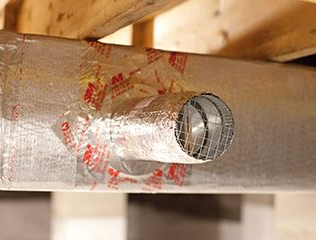
A crawl space supply air inducer is a purpose-built connection to the supply side of the home's HVAC ductwork that allows a small, controlled amount of conditioned air to enter the crawl space.
It is not simply an open hole cut into a supply trunk.
The type of inducer I use is insulated and includes a backdraft damper so crawl-space air cannot freely flow backward into the HVAC system when the system is off. It also incorporates insect and rodent screening to help keep pests from using the opening as an access point.
In practical terms, the device is designed to do a few simple things:
- connect to the home's supply ductwork
- deliver a small, controlled amount of conditioned air
- prevent reverse airflow with a backdraft damper
- remain insulated to reduce unwanted condensation and temperature transfer
- provide screening against insects and rodents
- condition the crawl space without dumping a large amount of HVAC air into it
One example of the type of product I am talking about is the Crawlspace Depot Supply Air Inducer. Crawlspace Depot describes its unit as attaching to the supply side of the ductwork, introducing approximately 50 CFM of conditioned air, and using a backflow damper to prevent crawl-space air from entering the HVAC system.
The goal is not to make the crawl space the same temperature as the living area.
The goal is to influence the crawl-space environment enough to keep dew point, condensation, and wood moisture below levels that support mold and fungal growth.
That only works when the crawl space is already closed. The foundation vents need to be sealed, the crawl space door needs to be reasonably tight, uncontrolled air openings need to be reduced, and ground moisture needs to be controlled with a vapor barrier.
The supply air inducer is the conditioning component of that system, not the entire system by itself.
The First Step Is Keeping Humid Outside Air Out
In a traditional vented crawl space, warm humid outdoor air enters through foundation vents, crawl space doors, and other openings.
During summer, that air enters a space that is often cooler because of the air-conditioned house and cold ductwork above it.
That is where the problem starts.
The first job in a closed crawl space is therefore to reduce uncontrolled outdoor-air entry.
Once that happens, the remaining moisture load is much smaller and typically consists of minor exterior air leakage, some ground-moisture evaporation, and moisture interaction with the house above.
That is a much easier environment to control.
Does The Vapor Barrier Need To Be Fully Sealed To The Walls?
No. A supply air inducer does not require a fully wall-sealed liner to work.
The more important moisture-control variable is keeping humid outdoor air from entering the crawl space through foundation vents, doors, and other uncontrolled openings.
Advanced Energy, working with the U.S. Department of Energy, performed field research on closed crawl spaces using conditioned supply air. That research showed that closed crawl spaces could maintain very low and stable wood moisture content while vented crawl spaces remained wetter.
The important takeaway is that closing and air-sealing the crawl space was the major moisture-control change.
The main problem was humid outdoor air entering through foundation vents and other openings.
Once those air pathways are controlled and the ground is well covered with a vapor barrier, the remaining ground-vapor load is relatively small.
That is why I do not consider a fully sealed wall liner a requirement for conditioned supply air to work.
In many low, flat coastal crawl spaces, I am comfortable using a well-installed pinned ground vapor barrier combined with conditioned supply air.
If the vents, crawl-space door, and other major air openings are sealed, the ground is well covered, and the crawl space is performing properly, gluing the vapor barrier to every inch of foundation wall does not automatically create a better moisture-control system.
A fully sealed wall liner can still be the right tool when it has another job to do.
For example, I may prefer a fully sealed liner when I need to:
- direct water beneath the liner in a sloped clay crawl space
- support a radon-mitigation strategy
- create a more finished and usable crawl space
- address specific drainage or site conditions where wall coverage provides a real benefit
The point is not that fully sealed liners are bad.
The point is that they are not inherently required for supply air to work.
The crawl space should be judged by performance.
If the dew point stays below surface temperatures, condensation is controlled, and the wood remains dry, the system is doing its job regardless of whether the ground cover is pinned or fully sealed to the walls.
For a deeper explanation of when each approach makes sense, see “Pinned Vapor Barrier vs. Fully Sealed Liner: When Is Each the Right Choice?”
Relative Humidity Is Only Half The Moisture Equation
Most homeowners think about crawl-space moisture in terms of relative humidity.
Relative humidity matters, but dew point matters just as much.
The basic rule is simple:
Keep the dew point below the temperature of the crawl-space surfaces.
If the dew point stays below the temperature of the joists, ductwork, pipes, vapor barrier, and other surfaces, condensation does not occur.
That is why a relative-humidity number by itself can be misleading.
A crawl space can temporarily show a higher RH without being in danger if the surfaces are warm enough that the air still cannot condense on them.
The real concern is when moisture-laden air with a high dew point meets a surface cold enough to fall below that dew point.
Condensation Requires Two Ingredients
Condensation requires two conditions at the same time:
- Air with a high enough dew point
- A surface cold enough to fall below that dew point
This is important when people ask what happens during spring or fall if the homeowner opens the windows and the HVAC system is not running much.
Relative humidity may rise during those periods, but the floor system, ductwork, and crawl-space surfaces are generally warmer too.
Higher RH by itself does not automatically create condensation.
The greater risk usually comes during hot, humid weather when outdoor dew points are high and air conditioning is creating colder surfaces beneath the home.
Those are also the conditions when the HVAC system is likely to run more often.
Why Such A Small Amount Of Supply Air Can Work
I generally like about 1 CFM of supply air for every 30 square feet of crawl space, and I usually do not want to go below that.
For a 1,200-square-foot crawl space, I would typically be around 50 CFM.
That does not sound like much air, but it does not need to be.
The crawl space has already been closed off from most of the humid outdoor air. The supply air only has to influence the environment enough to keep dew point and wood moisture from entering the danger zone.
It also helps that the crawl space is not completely isolated from the house above.
The Crawl Space And First Floor Interact
The crawl space and first floor are not fully blended, but they do interact.
Temperature, humidity, framing moisture, flooring materials, and air movement create overlap between the two spaces.
If crawl-space humidity rises somewhat, the framing and other materials may absorb some moisture while also being influenced by the conditioned first floor above.
The crawl space and house can therefore help or hurt each other.
That is another reason the supply air inducer does not have to carry the entire crawl-space moisture load by itself.
It only needs to provide enough conditioning that the crawl space remains below the point where condensation and excessive wood moisture become a problem.
I Have Seen Supply Air Work In Extremely Wet Coastal Crawl Spaces
My confidence in supply air is not based only on theory.
I have personally seen supply-air systems dry out some of the wettest crawl spaces I have worked in near the Great Dismal Swamp and Back Bay in the Hampton Roads area.
Those areas are about as challenging as crawl-space conditions get locally. The soils stay wet, summer humidity is severe, and condensation pressure can be extreme.
If there is a place where a marginal moisture-control method is going to fail, that is the type of environment where I would expect to see it.
Instead, I have seen properly designed supply-air closed crawl spaces dry down and maintain acceptable wood moisture even in those conditions.
That field experience is one of the reasons I consider conditioned supply air a highly proven and reliable moisture-control method, not simply an inexpensive substitute for a dehumidifier.
That does not mean I use it blindly in every crawl space. Site conditions still matter.
But I have seen it perform in some of the harshest coastal crawl-space environments we have.
Wood Moisture Content Is The Number I Care About Most
Ultimately, I care about what the wood is doing.
My upper limit is about 16% wood moisture content, and I prefer to see the framing average closer to 11%.
Relative humidity can move around.
What I do not want is framing that remains wet enough to support mold and fungal activity.
That is why I judge a moisture-control system by the condition of the wood, not by whether a humidity meter always shows the prettiest possible number.
The objective is dry wood.
Verify The System By Checking The Wood
No crawl-space moisture-control system should simply be installed and assumed to work forever without checking actual performance.
If the framing stays comfortably below 16% wood moisture content and preferably averages closer to 11%, the system is doing what I want it to do.
If the framing remains too wet, that tells me there is another moisture load or weakness somewhere in the system.
That might mean better air sealing, more supply air, drainage correction, a better vapor barrier, or a dedicated dehumidifier.
The system should be judged by results.
Supply Air Versus A Dedicated Dehumidifier
A dedicated dehumidifier is the more aggressive and precise moisture-control system.
When it is operating properly, it gives direct control over crawl-space humidity.
The downside is that if it stops working, it can stop without the homeowner knowing.
A supply air inducer is more passive, but it has a reliability advantage because it works whenever the home's HVAC system operates.
That creates a somewhat self-protecting relationship.
The same air conditioning that helps create cold floor and duct surfaces also causes the supply air inducer to deliver conditioned air into the crawl space.
That is one of the reasons I like supply air systems. They are simple and require very little maintenance.
Supply Air Can Be The Most Practical First Step
Supply air is also usually much more affordable than installing a dedicated crawl-space dehumidifier system.
That matters because homeowners do not make crawl-space decisions in isolation.
They may already be paying for mold cleanup, insulation removal, duct repairs, vapor-barrier work, rodent damage, or structural repairs.
If someone has elevated wood moisture and active mold or fungal growth but is limited in how many thousands of dollars they can spend at one time, a properly designed supply-air system can be a practical first-stage solution.
If the crawl space can be sealed properly and the site conditions are favorable, supply air may control the moisture problem without forcing the homeowner into the most expensive possible system on day one.
That is not cutting corners.
It is using a proven moisture-control method that fits both the building and the homeowner's budget.
Moisture Control Does Not Have To Be All Or Nothing
Choosing supply air does not mean the crawl space can never receive a dehumidifier later.
A moisture-control system can be built in stages.
If the crawl space is closed properly, the supply air is installed, and the wood dries down and stays dry, nothing else may be needed.
If summertime monitoring later shows wood moisture running higher than I want, dew point getting too close to surface temperatures, or some other remaining moisture problem, a dedicated dehumidifier can be added.
Nothing about the supply-air system prevents that.
You can also use both systems together.
The important point is that the first step does not have to be the last step.
The System Is Somewhat Self-Protecting
During mild spring or fall weather, the HVAC system may not run much and relative humidity in the crawl space may rise somewhat.
That does not automatically mean the system is failing.
If the weather is mild enough that the air conditioner is not running, the crawl-space surfaces are generally warmer too.
When outdoor conditions become hot and humid enough for dew point to climb and condensation risk to increase, the air conditioner normally runs more frequently.
That is also when the supply air inducer delivers more conditioned air into the crawl space.
So the conditions that create the greater risk also tend to activate the system more often.
Supply Air May Also Help The Duct Environment
Homeowners sometimes worry that introducing 40 or 50 CFM into the crawl space will rob the house of conditioned air and make the HVAC system perform worse.
I do not think that is necessarily what happens.
By bringing the crawl-space environment closer to indoor conditions, you reduce the temperature difference surrounding the first-floor ductwork.
The ducts are no longer running through as extreme a hot, humid environment.
That may reduce losses through the duct system and create a more favorable environment around the ductwork.
Supply Air Should Not Heavily Pressurize The Crawl Space
Supply air should be introduced in a controlled amount.
The goal is not to heavily pressurize the crawl space or force large amounts of air through floor penetrations, plumbing openings, or other leakage paths.
I want the pressure difference between the crawl space and the house to remain relatively small.
We are trying to influence the crawl-space environment, not turn it into a separate conditioned room with a large HVAC supply.
That is another reason relatively small airflow rates make sense.
Supply Air Is Not Right For Every Crawl Space
I do not use supply air simply because it works in many closed crawl spaces.
The site conditions still matter.
I am more likely to choose a dedicated dehumidifier when the crawl space has:
- no practical ductwork available for supply air
- more ground moisture than I am comfortable with
- a long history of severe mold or fungal growth
- a poor duct layout for distributing conditioned air
- an oversized HVAC system that may not run long enough
- unusually leaky foundation walls
- another above-average moisture-load condition
If I am not confident in the moisture load or the ability to air-seal the space properly, I would rather use the more aggressive control method.
The Installation Still Has To Be Right
A supply air system can perform poorly if the rest of the crawl space is poorly designed.
The biggest mistakes are poor air sealing, a bad vapor-barrier installation, excessive uncontrolled exterior leakage, or simply not providing enough CFM for the size of the space.
I also prefer removing floor insulation when I am treating the crawl space as part of the first-floor environmental zone.
In my experience, that allows the crawl space and first floor to interact more naturally instead of trying to isolate them with old fiberglass between the floor joists.
The supply air system works best when the crawl space is actually designed as a closed system.
When I Choose Supply Air And When I Choose A Dehumidifier
My rule is pretty simple.
If I am confident the crawl space can be air-sealed well, the vapor barrier is good, the moisture history is reasonable, and the duct layout makes sense, I am comfortable using conditioned supply air.
If I am not confident I can seal the space well, if the crawl space has had a severe history of mold and fungal growth, or if there are other variables suggesting an unusually high moisture load, I use a dedicated dehumidifier.
And if I want the benefits of both, I can use both.
Conclusion: Judge The Crawl Space By Performance
The easiest mistake is to look at a 40 or 50 CFM supply air inducer and ask how that small amount of air can possibly control an entire crawl space.
The answer is that it is not trying to control an uncontrolled crawl space.
The major moisture problem has already been reduced by sealing vents, limiting exterior-air leakage, and controlling ground vapor.
Once that happens, the supply air only has to keep the remaining conditions from crossing into the danger zone.
It influences humidity, temperature, and dew point. It helps prevent condensation. It helps keep the framing dry.
A dedicated dehumidifier is still the more aggressive and precise tool, and there are crawl spaces where I prefer one.
Supply air has different advantages: it is simple, passive, reliable, lower-maintenance, and often much more affordable.
I have also seen it work in some of the wettest, most humid crawl spaces in the Hampton Roads area. That is why I consider it a highly proven and reliable method of keeping a properly designed closed crawl space dry, not an experimental alternative or a second-rate substitute.
That can make it an excellent first step for a homeowner who needs to get wood moisture under control quickly but cannot spend several thousand more dollars on a dedicated dehumidifier system at the same time as every other crawl-space repair.
And it does not lock the homeowner into anything.
If the framing stays dry, the system is working.
If future monitoring shows the crawl space needs more control, add the dehumidifier.
The point is not to install the most equipment possible or chase one perfect relative-humidity number.
The point is to prevent condensation and keep the wood dry enough that mold and fungus cannot take hold.
If the system does that, it is doing its job.
Summary Of Advanced Energy DOE Supply Air Crawl Research
